The Future of History

Saturday, 24 December 2011

Camelot - City of the Legion


In the last blogpost we considered the information divulged by Lambert of St Omer in 1120 that the palace of Arthur the warrior was in 'Pictland'.  We noted that the massive Roman military encampment of Colania - now the Camelon suburb of Falkirk in Scotland - was known locally, at least as late as the eighteenth century, as "Camelot".

The earliest literary reference to Arthur's Camelot comes down to us from the romance of Lancelot, the Knight of the Cart by the French poet, Chretien de Troyes:

Upon a certain Ascension Day King Arthur had come from Caerleon, and had held a very magnificent court at Camelot as was fitting on such a day.

Chretien seems to have based his vision of Camelot on the Roman city of Camulodunum, now Colchester in Essex, which had been the capital of Roman Britain in the first century AD and the first major settlement to be razed by Boudica's violent uprising of AD 60.  The name Camulodunum came from Camulos, a Celtic god of war, analogous to the Roman Mars.  The city of Camulodunum was also the site of a colonia - a sort of retirement home for Roman army officers.

It does not require too much imagination to see how Camulodunum could have been romanticised by a French poet of the twelfth century, becoming the fabled city of Camelot.  It is also not difficult to see how the Roman colonia at Colchester might have been confused with the Roman fort of Colania just north of the Antonine Wall.

Even more striking, though, is an age old association of the Colania encampment at Camelon (or 'Camelot') with a place called Camulodunum, the Fort of Camulos, the War-God.

George Buchanan was a Scottish historian of the sixteenth century and tutor to the future King James I of England.  Very much a figure of the Scottish Reformation - a dour, Calvinist affair - Buchanan was not a man to be carried away by romantic notions.  He wrote of the Antonine Wall which created a barrier across central Scotland, from the Forth to the Clyde, and noted that "where it touched the River Carron, [it] had a garrison or fortress which, by its situation and the termination of a number of roads there, had the appearance of a small city, which some of our writers falsely imagine to have been Camulodunum".  Buchanan preferred to think of this ancient "small city" as the city referred to by Bede, the eighth-century historian of the Angles, as Caer-Guidi: the City of the Men of the Forth.

But Buchanan's belief that the fortress beside the River Carron could not have been Camulodunum wasn't shared by everybody.  Robert Sibbald, in his Historical Inquiries of 1707, did wonder whether the ancient city couldn't have been "Camulodunum Brigantium, which the vulgar call at this day Camelon near Falkirk".  This is an interesting remark.  Sibbald seemed to be arguing that, while Buchanan had been right - Camelon was not Camulodunum, because that had been Colchester, many miles to the south - it was still possible that Camelon had been Camulodunum Brigantium or, if you prefer, the Camelot of the North.

Brigantia was a major mother-goddess, a sort of Celtic Venus.  She came to be venerated in Ireland as Brighid (later St Bridget) and in the Hebrides as Bride (pronounced "breed": the Hebrides were the "Islands of Bride").  She is similarly remembered throughout much of Britain in the various Bridewells and St Bride's, and she seems to have been the particular patron of the Britons of the Pennines, a tribal federation known in Roman times as the Brigantes.

If Sibbald was right, then the Camelon fortress - just nine miles south of Arthur's Round Table at Stirling, and very much on the front line of sixth-century Britain - was a remarkable fortified city dedicated to two Celtic war gods, Camulos and Brigantia.  It would also help to explain how Arthur's main military stronghold in central Scotland came to be thought of as "Camelot".  It was a Camulodunum in its own right, a mighty citadel as impressive as the other Camulodunum of Essex, only it was the mainstay of the North Britons and easily one of the most important military stations in the Old North.

Chretien, in his romance of Lancelot, seems to have implied that "Camelot" was another name for "Caerleon".  Here's where things tend to get confusing.  If Chretien modelled his Camelot on Colchester in Essex, then how could it have been the same place as Caerleon, which many scholars have assumed was the old Roman fortress of Isca, now Caerleon-on-Usk in south-east Wales?  The two places are simply too far apart to have been the same - and, what is more, neither is properly connected with the historical Arthur.

In fact, Caerleon simply meant the City or Fort of the Legion (Caerllion, in Welsh).  As we saw in the last blogpost, the Colania fortifications at Camelon had been constructed by a detachment of the XX Legion; it was there that (in the words of the Roman poet Claudian) the imperial legionaries had curbed the "savage Scot" and scanned the "lifeless patterns tattooed on the dying Picts".  Furthermore, the City of the Legion was remembered as the site of one of Arthur's major battles.  The Welsh monk Nennius, writing early in the eighth century, noted that Arthur's ninth victory was won in a battle "in the City of the Legion".

The likelihood is that this battle was triggered by an attempted invasion of Irish warriors from Ulster.  The Irish Annals record the "first expedition of the Ulaid to Manau" in 577.  Manau Gododdin was the western spur of the British-held territory of Lothian - that is, it was the volatile region around Stirling, immediately to the south of the River Forth.  The Ulaid, who gave their name to the province of Ulster, were the long-time enemies of Arthur's people (the tribe of Riata) in Ireland, and for some reason they decided in 577 to cross the Irish Sea and, under the leadership of their chieftain Baetan mac Cairill, to seek to wrest the strategic bulwark of Stirling and the borderland between the Britons and the Picts from Arthur and his family.

A few posts back, I showed that it was possible to date Arthur's twelfth battle ('Mount Badon') to the year 580, when Arthur successfully defended the Highland kingdom of his kinsman Bruide against an attack by the southern Picts.  The year 577 would therefore be about right for Arthur's ninth battle, fought in defence of his principle fort in Manau Gododdin, the enemy on this occasion being the warriors of Ulster and their king, Baetan, whom medieval genealogists in Ulster would cheerfully - if erroneously - describe as ri Erenn ocus Alban: "King of Ireland and Scotland".

Arthur's ninth battle at the "City of the Legion" - Caerleon, or Camelot, as Chretien de Troyes knew it was also called - was evidently a success for Arthur the warrior.  The warriors of the Ulaid returned to Ireland the following year (there appears to have been another battle fought between Arthur's coalition and the Ulaid in 578, probably at the Fords of Frew near Stirling, a few miles to the north of Camelon), and another enemy was chased out of North Britain.  It all added to Arthur's fame as a brilliant military commander, the land-holder of Manau, whose main stronghold stood between the Antonine Wall and the River Carron.

The place we came to know as Camelot.

Saturday, 17 December 2011

Camelot - An Introduction


In the last blogpost we glanced at the argument that there is "no evidence" that Artuir mac Aedain (c. 559 - 594) was the original King Arthur.  It's completely untrue, of course.  There's quite an abundance of evidence that Artuir was Arthur 'the Emperor'.

Lambert of St Omer was a Benedictine monk, born in the latter half of the eleventh century, who in 1065 was chosen abbot by the monks of St-Bertin and the canons of St Omer in France.  He is best known for his Liber floridus or "Book of Flowers", which he completed in about 1120.  It is essentially a medieval encyclopedia, and it discloses some interesting information about Arthur.

Building on the work of the ninth-century Welsh monk known as Nennius, Lambert of St Omer wrote in his Liber floridus that -

"There is in Britain, in the land of the Picts, a palace of the warrior Arthur, built with marvellous art and variety, in which the history of all his exploits and wars is to be seen in sculpture.  He fought twelve battles against the Saxons who had occupied Britain."

One or two things immediately stand out from this statement.  Firstly, in referring to the 'palace of Arthur the warrior Arthur' (palatium ... Artuir militis) Lambert seems to have plumped for the Scottish spelling of Arthur's name - Artuir.  Secondly, he locates this palace firmly in the 'land of the Picts', or what we would now term Scotland.

It has long been suspected that the 'palace' referred to by Lambert was the structure known, at least since 1293, as 'Arthur's O'en' or Arthur's Oven (Furnum Arthuri).  This was a Romano-British temple, supposedly erected by Vespasian in honour of the Emperor Claudius, not far from Falkirk in central Scotland.  The circular temple was later described as 'an old building in the form of a sugar-loaf, built without lime and mortar', and though it was destroyed in the eighteenth century an exact replica can be found among the stables of Penicuik House in Edinburgh.

The assumption that Lambert's 'palace of Arthur the warrior' was the Arthur's Oven temple is quite probably wrong.  More likely, that 'palace' was a Pictish roundhouse which stood on raised tableland overlooking the River Carron a short distance away.  One manuscript based on the ninth-century work of Nennius claims that a Roman commander built 'upon the bank of Carron a round house of polished stone, erecting a Triumphal Arch in memorial of a victory'.  The same site seems to have been referred to by the sixteenth-century Scottish historian Hector Boece as the palace of one Cruthneus Cameloun, a supposed 'king of the Picts'.  Today, the place is known as Camelon.

In the middle of the second century AD, the Roman army constructed a turf-and-stone rampart across the pinched waist of Scotland, from the estuary of the Clyde to that of the Forth.  This wall, named after Antoninus Pius, passed a short distance to the south of the Pictish roundhouse which stood on the bank of the River Carron, and which would appear to have been commandered by Vespasian.  Around it, a detachment of the XX 'Valiant and Victorious' Legion built a large fortress, which eventually grew to include two large encampments and ten smaller marching camps.  The Romans called this place Colonia.  The imperial army abandoned these impressive fortifications later in the second century, and no doubt the great fortress of Colonia was gratefully occupied by the local Picts.

Much of this 'little ancient city' still existed in Arthur's day.  As late as the year 1720 it was recorded that 'We may still discern the track of the streets, foundations of buildings and subterranean vaults.  The country people call it Camelon or Camelot.'

Twenty-five years earlier, in 1695, Edward Gibson, Bishop of London, revising William Camden's earlier Britannia, had remarked of the Colonia site: 'There is yet a confused appearance of a little ancient city ... They [the 'common people' of the locality] call it Camelot.'

Clearly, the ancient fortifications at Camelon were also known as Camelot.  Camelon has two-syllables - 'came-lon' - and the place is known in the Scots dialect as Kemlin or Caimlin.  In Gaelic, it is Camlan, a place of unparalleled consequence in the legends of King Arthur.  The site of his last battle, in almost every telling of his tale, was Camlan.

It is also worth noting that the site of Arthur's Round Table, as explained in a previous post, was just nine miles away to the north, along what would once have been a Roman road.  This road led into the wild lands of the native Picts from the Antonine Wall, which passed to the south of the Colonia fortress.  The fortress had clearly been built to guard a ford across the River Carron, on what was at one time the very boundary of Pictish territory.  Here was where the legionaries of Rome had come face-to-face with the tattooed Picts.  An anonymous correspondent of 1697 provided the local knowledge that a paved (Roman) road had crossed the River Carron near this ancient fort.  At the end of this road stood 'a great castle, called by the country folks the Maiden Castle'.  The site was surveyed by General W. Roy in the eighteenth century: he noted that the 'town' must have been 'one of the most considerable stations belonging to the Romans in North Britain'.  The particular mound beside the River Carron as surveyed by Roy was excavated during the twentieth century, when it was discovered that the mound, which was fortified by a several ditches and a palisade, supported two circular houses of timber.  One of these was perhaps the 'palace of the Picts' described by Hector Boece in the sixteenth century; the other might have been the 'Maiden Castle' referred to in 1697.  Both formed part of what was known locally as 'Camelot'.

Let us suppose, then, that the 'palace of Arthur the warrior' mentioned by Lambert of St Omer in 1120 was not the Arthur's Oven temple but rather the fortified roundhouse or 'palace of the Picts' nearby, which was also 'one of the most considerable stations belonging to the Romans in North Britain'.  This was the very fortified enclosure or 'little ancient city' which was known locally, a thousand years after Arthur, as Camelot.

Lambert of St Omer's testimony concerning 'Artuir the warrior' in the land of the Picts is of great importance.  His "Book of Flowers" appeared nearly twenty years before Geoffrey of Monmouth's History of the Kings of Britain.  Geoffrey's work can be thought of as the first Arthurian bestseller, but it played havoc with British history.  It is to Geoffrey that we owe the myth that King Arthur was born at Tintagel in Cornwall, and that the climactic battle of his career was fought nearby on the River Camel.  Geoffrey therefore placed his King Arthur a long way away from Pictland, although he did have Arthur fighting battles in and around the western end of the Antonine Wall.  Geoffrey's account was in many ways the inspiration for subsequent versions of the legends; Lambert's account, by way of contrast, is barely known.  But it is Lambert's reference to the Arthur's palace in the land of the Picts that is almost certainly the more accurate of the two.

The very obscurity of the Lambert reference is illustrative of the King Arthur conspiracy.  It puzzles scholars - "How could Arthur's palace be in the land of the Picts?" - but only because it is anathema to them to admit that there was an Arthur in Scotland.  Rather, they continue the false trails left by Geoffrey of Monmouth.  Lambert also mentioned the existence of stone sculptures depicting the twelve legendary battles of Arthur.  England - so far as I am aware - has nothing to compare with the many fantastic examples of Pictish stone carvings which display images of battle and which have been found over much of the Arthurian region in the province of the southern Picts, against whom Arthur would die fighting in 594.  It is quite possible that some of these magnificent Pictish stone carvings actually relate to the historical Arthur's battles in central Scotland (I'm looking forward very much to Iain Forbes's The Last of the Druids: The Mystery of the Pictish Symbol Stones, published shortly by Amberley, to see what light he is able to shed on these fascinating carvings).

Once again, though, we find evidence for an Arthur in Scotland when no such hard evidence exists for one further to the south.  Another plus for Artuir mac Aedain: the first, and probably the only, Arthur.

Sunday, 11 December 2011

The Badon Conundrum


The King Arthur Conspiracy has a Facebook page which gives occasional updates on the book.  Someone went on there recently to leave a comment:

"King Arthur was never Scottish!!!!"

The only real answer to that confident, though unsupported, assertion was that Arthur's father was Scottish, but his mother and paternal grandmother were British - making him three-parts "Welsh".

But the insistence that "King Arthur was never Scottish" is an interesting one.  It keeps coming back in various forms.  One I've heard several times is: "There's no evidence that Artuir mac Aedain was the original Arthur."  In fact, there's no evidence for lots of things ... until you look.  Then the claim gets modified, becoming: "Artuir mac Aedain has been thoroughly investigated and there's no evidence that he was the original Arthur."  Well, that one's rather more dishonest.  I spent eight years investigating Artuir mac Aedain and came across very little evidence indeed that he had been "thoroughly investigated" by anybody.  What is more, those I discovered who had looked into his candidacy tended to have formed the opinion that he probably was the original Arthur.

It so happens that the earliest references to a man named Arthur (Gaelic Artuir) in the historical records belong to what we now call Scotland (specifically, those references occur in the Irish Annals and Adomnan's Life of St Columba, both of which ultimately originated on the Isle of Iona).  The earliest references to Arthur in early British poetry were made by sixth-century poets specifically associated with the North (Taliesin and Aneirin).  The early Welsh tales of the Mabinogion consistently associate Arthur with historical princes of sixth-century North Britain (Owain, Cynon, Caw, Peredur, etc.).  In Arthur's day, Edinburgh, Stirling and Dumbarton were all British, and it is in those places that we find Arthur fighting.

By way of contrast, the ideas that Arthur was born at Tintagel in Cornwall and was buried at Glastonbury in Somerset didn't come along until five or six hundred years after he died.  And yet, there are those who insist that we should be looking for Arthur in those areas, rather than in the region where Arthur was first mentioned.  Because no Arthur has actually been discovered in the south, a whole list of candidates have been put forward for the coveted role of the "original" Arthur.  These candidates are all known by names other than Arthur and most of them did not originate in the British Isles.  Not one of them can be associated with any of the other heroes who accompanied Arthur into the legends.  They have been nominated, not because they are realistic candidates for the original Arthur, but because too many people stubbornly refuse to examine the credentials of Artuir mac Aedain, the historical prince of the North who also happens to have been the first Arthur on record.

There is only one piece of "evidence" which appears to link Arthur with the south.  This is his famous victory at the Battle of Badon.  We first hear of the "siege of Badon Hill" from St Gildas, who was writing in the middle of the sixth century.  He did not mention Arthur.  The next reference to a "Battle of Mount Badon" comes from Nennius, a Welsh monk writing early in the ninth century.  This battle was the twelfth of Arthur's epic victories.  There is nothing in Nennius's work to indicate that the "Battle of Mount Badon" was the same as the "siege of Badon Hill" mentioned by Gildas.

Next, scholars point to a couple of entries in the Welsh Annals.  The first of these purports to record the "Battle of Badon in which Arthur carries the Cross of Our Lord Jesus Christ for three days and three nights on his shoulders and the Britons were victors" as having taken place in the year 518.  There are several problems with this entry.  First of all, it was obviously interpolated at a much later date.  Secondly, the date it gives for the battle - 518 - doesn't square with the testimony of St Gildas.  Gildas wrote that the battle had taken place 44 years before he was born.  If the entry in the Welsh Annals was correct, then Gildas would have been writing his De Excidio et Conquestu Britanniae in about 562.  But St Gildas went on to chastise a number of his contemporary British princes, including Maelgwyn of Gwynedd, who died in 547 (or 549).  So somebody got their dates wrong, and the balance of probabilities would suggest that it was the annalist who retrospectively added the entry for the "Battle of Badon" to the Welsh Annals who made it all up.

There can be little doubt that a "siege of Badon Hill" took place towards the end of the fifth century AD, probably in southern Britain.  The Welsh name for the city of Bath is Caerfaddon (from baddon, a 'bath'), and so that would seem a likely place for the siege mentioned by St Gildas.  This, though, was not the battle at which Arthur fought.  He had not even been born when that siege took place.

The "battle of Mount Badon" must have been a different battle.  Only the similarity of the names creates confusion.  It is as if somebody muddled up the Siege of Yorktown in 1781 with the Battle of Yorktown in 1862.  They sound alike, but they were completely different battles fought in completely different wars.

For Arthur's Mount Badon, we need to remember that the Gaelic bad is a common element in place-names.  It is easily confused with the Welsh bad or baddon - a 'bath' - but it means something else entirely: a grove or a thicket, a plain or a 'spot'.  The Irish records indicate that a battle was fought in 580 in the Angus region of Scotland, and that the loser was Galam Cennaleth, the leader of the southern Picts.  These same southern Picts were the sworn enemies of Arthur, and in the account left by Adomnan of Iona we find Arthur losing his life in 594 fighting against these very Picts.

The Picts in question inhabited the 'land of Circinn', a Pictish province designated by the term cir - a crest or a 'comb'.  The spearmen of this territory distinguished themselves by adopting the appearance of a boar, either by wearing their hair in Mohican style or donning the 'crest' of a boar.  One of the earliest Arthurian tales - Culhwch and Olwen - features a major boar-hunt at which one of Arthur's comrades comes to grief, being poisoned by the bristles of a dangerous boar.  The same legend is told of a valley in Angus, Scotland, where a great warrior is poisoned by a boar he has just killed.  Adjacent to that very valley is a hill called Badandun.  Badandun - or "Mount Badon" in English - reveals in its topography the name of the warrior who died while attacking the boar-warriors of Galam Cennaleth: his name was Fergus, and he was the constant companion of Arthur's nephew Drystan (St Drostan to the Scots, Sir Tristan to the medieval romancers).

The date of Arthur's battle at Badandun Hill - 580 - is rather revealing.  According to the Welsh Annals, Peredur of York (later to evolve into the romantic Sir Perceval) died in 580 (in fact, he died several years later).  The Spanish Anales Toledanos, meanwhile, state that the infamous Battle of Camlan was fought in 580.  Though this, too, is somewhat inaccurate, it does suggest that a memorable Arthurian battle was fought in 580 - and, second only to Camlan, the most memorable of all his battles was that of "Mount Badon".

Politically, the Battle of Badandun was fought to relieve pressure on Bruide son of Maelgwyn, a kinsman of Arthur's who was also the king of the northern Picts.  Arthur's half-brother Gartnait was poised to succeed Bruide as the High-King of the Highlands, and so by destroying the rebellious southern Picts and their boar-like chieftain Galam Cennaleth, Arthur was effectively securing the Highland throne for his half-brother.

The "siege of Badon Hill" in the south, meanwhile, continues to pose problems.  No one knows for sure when it was fought or even where.  The only near-contemporary reference to it fails to mention Arthur.  But the myth that King Arthur was a warlord of southern Britain is founded almost entirely on the assumption that this rather difficult-to-pin-down battle was also the "Battle of Mount Badon" at which Arthur fought.

As usual, the Scottish Arthur yields a great deal of information about the "Battle of Badon" while the "English" Arthur creates nothing but confusion and disagreement.  Still, we are continually being told that "King Arthur was never Scottish!!!!" and that there's "no evidence that Artuir mac Aedain was the original Arthur".  Yeah - and if you believe that, you'll believe anything.

Thursday, 8 December 2011

The Sword and the Stone


One of the most enduring images from the Arthurian legends is that of the young Arthur pulling the sword from the stone and thereby proving that he is the true king.  Here's how the stone was described by Sir Thomas Malory in his fifteenth-century Le Morte d'Arthur:

And when matins and the first mass was done, there was seen in the churchyard, against the high altar, a great stone four square, like unto a marble stone; and in the midst thereof was like an anvil of steel a foot high, and therein stuck a fair sword naked by the point, and letters there were written in gold about the sword that said thus:- Whoso pulleth this sword out of this stone and anvil, is rightwise king born of all England.

You could search high and low for such a stone in England, and you wouldn't find it.  The reason being that the stone in question does not really belong to any English tradition.  That said, however, at the time when Sir Thomas Malory was writing, the stone in question had been in England for nearly two hundred years.

The tradition of the sacred stone of kingship actually belonged to the Scots.  According to the mythic history of the Scots, or 'Gaels', the stone was brought out of Egypt by the legendary Gaedal Glas or Gathelus, the supposed ancestor of the Scots.  Writing in 1527, the Scottish historian Hector Boece explained it thus:

Gathelus, an Athenian or Argive, travelled from Greece to Egypt, where he married Scota, daughter of Pharaoh.  At the Exodus, Gathelus fled with Scota to Iberia, where he founded a kingdom at Brigantium, now Santiago de Compostella.  There, Gathelus reigned in the marble chair, or fatal stone like a chair: wherever it was found would be the kingdom of the Scots.  Simon Breck, a descendant of Gathelus, then took the chair from Spain to Ireland, and was crowned king of Ireland in it.

Tradition holds that the 'marble stone' followed the Scots to their original power base in Argyll, on the west coast of what is now Scotland.  Andrew of Wyntoun, writing his Orygynale Cronykil of Scotland in the fifteenth century, noted that it was the great-great-grandfather of Arthur who brought the stone to the sacred island of Iona in about the year 498:

Fergus son of Erc from him then
Did descend line by line
Unto the fifty-fifth generation,
As even man may reckon,
Brought this Stone into Scotland,
First when he can and won that land,
And set it first in Icolmkyll
And Scone thereafter was it brought unto.

The reference to the Isle of Iona (Icolmkyll - the 'Island of Columba of the Church) is especially intriguing.  Iona was a seat of kingship - reputedly, 48 kings are buried there, including Macbeth and Duncan.  What is more, one version of the story has Simon Brecc raising the marble stone from the sea off the coast of 'Ireland'.  Iona has a natural band of marble which stretches out into the sea from its south-eastern shore.  A block of this marble served as the altar of Columba's church on the island.  It could be, then, that in one of its early guises, the 'great stone four square, like unto a marble stone' was actually a bloc of Iona marble.

John of Fordun, a Scottish chronicler who wrote more than a century before Sir Thomas Malory described the 'great stone four square, like unto a marble stone', revealed that the 'fatal' stone of Scottish kingship, commonly known as the Stone of Destiny, bore its own inscription:

Ni fallat fatum, Scoti quocumque locatum
Invenient lapidem, regnasse tenentur ibidem.

['If Destiny prove true, then Scots are known to have been kings wherever men find this Stone.']

The legends of the Stone argue that it was originally the very stone on which Jacob laid his head at Bethel (Beth-El - 'House of God' - shares a linguistic origin with the Greek Baetylus, a sacred stone or pillar) and dreamt of a stairway to heaven.  As such, the Stone compares with various Middle Eastern sacred stones, the most famous of which is the 'Black Stone' or Ka'aba at Mecca.  The Ka'aba - Islam's holiest of holies - was once thought to house an aspect of Al-Uzza, the Arabic version of Venus.  In the Scottish tradition, the goddess housed in the Stone of Destiny was Scota, daughter of the Pharaoh and mother-goddess of the Scots.

The Stone of Destiny left the Isle of Iona and eventually found its way to Scone in Perthshire, taken there by Kenneth mac Alpin when he established himself as the King of Scotland in 842.  It was from Scone that the Stone was taken by the English king, Edward I, in 1296.  As anyone who has seen Braveheart will remember, Edward 'Longshanks' had convinced himself that Scotland belonged to him.  His removal of the Stone of Destiny from Scone meant that he had laid claim to the Scottish stone of kingship.  It has long been rumoured that the stone stolen by Edward I (see photo above) was actually just a random hunk of masonry, and that the genuine Stone of Destiny was safely hidden away.  Given that the early accounts of the stone refer to it as 'marble', it is possible that there was some truth in the notion that the canny Scots tricked Edward I into stealing an irrelevant bloc of locally-quarried Old Devonian red sandstone.

Edward I installed the Stone of Destiny in the coronation chair at Westminster Abbey.  Every English monarch, from Edward II in 1308 to Elizabeth II in 1953, was crowned whilst seated on the stone.

It is typical of the way in which the legends of Arthur were corrupted by English writers that the stone's inscription was altered from the original legend ('Wherever men find this Stone is the kingdom of the Scots') to 'Whoso pulleth this sword out of this stone and anvil is rightwise king born of all England'.

But how does this stone relate to Arthur?

In the spring of 574, a comet appeared in the skies.  This was almost certainly taken as an omen, a sign that a new king was about to be crowned (the Gaelic word for such a heavenly omen was dreag).  That same year, the Irish annals record a brutal battle in Kintyre.  The king of the Scots, Conall mac Comgaill, had died and a great battle was fought for the throne.  The victor was Aedan mac Gabrain, the father of Artuir.

St Columba, who had taken the Isle of Iona as the headquarters for his mission to Scotland, was reluctant to ordain Aedan as king of the Scots.  The saint had to be bullied into accepting Aedan's claim.  Still suffering from his ordeal, Columba returned to the Isle of Iona where he ordained Aedan as King of the Scots in the year 574 (the prophetic comet had been right!).  Present at this occasion - the first recorded instance of a king being ordained by a Christian in the whole of the British Isles - were Aedan's sons, including Arthur.  St Columba made use of the occasion to prophesy that Arthur would fall in battle, slain by enemies, and would never follow his father onto the throne.

The ceremony would have involved the 'fatal chair, or marble stone like unto a chair', as described by Hector Boece.  King Aedan would have knelt or stepped on the Stone of Destiny, which was expected to emit a shriek if Aedan was indeed the true king (in other words, the goddess Scota must have voiced her approval of his candidacy).  Aedan would then have swung his sword over the stone to demonstrate that he intended to govern the land and uphold its laws with the power of his arm.  The sword would not have been drawn out of the stone: rather, the stone represented the land (and the tutelary goddess who presided over the land) and the sword represented the authority of the king, whose rule was legitimised by a form of sacred marriage with the goddess of the land.  The power of the sword was drawn from the stone of the land.

It is rather amusing to note that the comet which flared in the skies over Britain in April-May 574 was not seen again until 1994.  Just two years later, the Stone of Destiny was finally returned, under military escort, to its proper home in Scotland, having spent a full seven centuries legitimising the rule of English monarchs.

Once again, though, we find that the 'English' Arthurian traditions were 'borrowed' from those of another culture - specifically, that of the Scots.  The 'fatal' stone was their royal stone, stolen by Edward I in 1296 and finally returned in 1996.  It was their Stone of Destiny which supposedly bore the inscription concerning kingship.  It was also the stone on which Arthur's father was ordained by St Columba on the Isle of Iona in 574, when the fifteen-year old Arthur was told that he would never be king of the Scots.

Try finding any Arthur in England who ever had anything to do with a sacred stone of kingship, and you'll enjoy a long and fruitless search.  There was no Arthur in England.  It is high time that, like the Stone of Destiny itself, he was at last returned to his Scottish roots.

Wednesday, 23 November 2011

The Round Table

When a question was raised in an online King Arthur forum about whether "England has the original Round Table", I read a few of the replies and felt moved to respond.

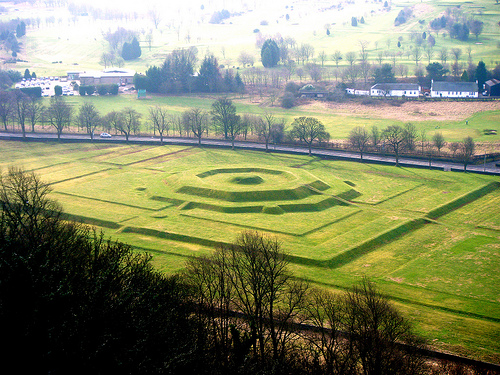
Back in August, this blog mentioned the news that researchers from Glasgow University, working alongside local historians and archaeologists, had surveyed the King's Knot near Stirling Castle ("Stop Press: Round Table Discovery").  A "circular feature" under the turf of the central mound - see above - was revealed by geophysicists.

I added that to the online discussion about the existence of the Round Table.  The exchange of ideas, views and information continued, but only one person referred, in passing, to what I had written:

"there is the recent news about the Stirling 'circular feature' tho I'm not convinced."

So that's that, then.  Another minor distraction safely buried.

Except that this wasn't "recent news".  I'd pointed out in my post that the French poet Beroul, writing his romance of Tristan in about 1200, had located the Round Table firmly at Stirling.  The Fair Yseut sends her squire with a message for King Arthur and is told that Arthur "is seated on his throne.  You will see the Round Table which turns like the world; his household sits upon it."  The squire makes his way to Stirling, where he finds Arthur "on the dais where all the knights were seated."

That was written 800 years ago.  Hardly recent news.

In the fourteenth century, the Scottish poet John Barbour composed his poem The Brus about the Battle of Bannockburn, fought a short distance south of Stirling in 1314.  The defeated English king Edward II rode desperately to Stirling, seeking shelter in the castle, but he was turned away by the castle's governor.  Edward and his followers galloped off; as John Barbour wrote:

And besouth the Castle went they thone,
Rychte by the Round Tabill away.

In 1478, one William of Worcester wrote that "King Arthur kept the Round Table at Stirling Castle".  A generation later, Sir David Lindsay bade a fond farewell to Stirling's Castle Rock:

Adew, fair Snawdoun, with thy towris hie,
Thy Chapell-royal, park, and Tabyll Round ...

As late as the sixteenth century, it was reported that the thousand-year old traditions were still being honoured at Stirling: "in a sport called 'Knights of the Round Table', the Institutions of King Arthur were commemorated."

King James VI of Scotland was christened at Stirling Castle in December 1566.  He was heralded as the new Arthur who would one day unite the thrones of England and Scotland, thereby recreating the Britain which had been divided by the Anglo-Saxon conquest.  Intriguingly, when he acceded to the throne of England in 1603, King James insisted on having exactly 24 counsellors to advise him.  Twenty-four was also the number of the 'horsemen' of Arthur's Court - the legendary Knights of the Round Table.

The stepped earthworks surrounding the central mound of the King's Knot were added for the benefit of King James's son, Charles I.  It is the central mound itself, which is about fifteen metres in diameter, which appears to have been the original "dais" upon which Arthur and his noble war-band met.  And it is this central mound which, as the archaelogical surveys carried out this summer showed, was topped by a "circular feature".

The relevance of the mound was partly strategic.  The River Forth, which curls round the Castle Rock at Stirling, was effectively the boundary of Britain.  Just two safe crossing places, the Fords of Frew, immediately to the west of Stirling, allowed Pictish warriors from the north cross into Britain.  The defence of those fords was integral to the security of North Britain.  For a while, that task was entrusted to Arthur's father Aedan, the 'Prince of the Forth'.  For several years, from about 575 until 584, the task fell to the "emperor" Arthur.  He fought at least one of his battles at the Fords of Frew on the River Forth.

But I also suspect that the Round Table mound was important to Arthur and his close-knit war-band for another reason.  It was the burial mound of their mutual ancestor, Brychan of Manau.

Manau Gododdin was the contemporary name for Stirling, the Gododdin people being the tribesmen of Lothian.  Brychan of Manau almost certainly had his own version of the Round Table - a "family" of twenty-four "sons" - which was replicated by Arthur.  After his death, according to a manuscript in the British Library (Cognatio de Brachan), the mighty Brychan was buried "in the island which is called Ynysbrachan and which is next to Manau".

The Welsh word ynys can refer to an island or a river-meadow.  The meadow on which the King's Knot stands, beside the River Forth, was next to Manau - that is, it lay immediately beneath the volcanic crag-and-tail rock of Stirling.

Brychan's remains might not have stayed in the King's Knot burial mound.  There is some evidence that one of Arthur's companions, St Cadog, exhumed them and carried them to the site of his new monastery, a little further to the north, near Doune (St Cadog is commemorated at Kilmadock).  But prior to that, it seems likely that Arthur's legendary band of inter-related warrior-princes met at the grave of their forefather, Brychan of Manau, and held their councils of war in the field beside the Castle Rock, on the very edge of Britain.

Not convinced?  That's up to you.  But you can't call it "recent news".

Tuesday, 22 November 2011

Here You Go

This might seem a bit premature - but then, there might be some out there who want to book early to avoid disappointment.

The book isn't due out until next summer, but Amazon are ready to take advance orders:

http://www.amazon.co.uk/King-Arthur-Conspiracy-Scottish-Mythical/dp/0752476858/ref=sr_1_2?s=books&ie=UTF8&qid=1321999216&sr=1-2

An excellent stocking-filler ... for Christmas next year!!

Saturday, 19 November 2011

Twelve Hundred Words

Part of this week was spent trying to explain in 1,200 words why Artuir mac Aedain, the "Scottish Arthur", is worth considering as a candidate for the Real King Arthur.

Sometimes, you can say a lot with a thousand words.  But it's also a case of deciding what not to include.  So that, for example, there was no space to point out that Edinburgh has Arthur's Seat while the Trossachs have Beinn Artair ('Arthur Mountain') and there are many, many other Arthurian place-names in Scotland.

Nope, no room for that.

Other things could only be alluded to, such as the battles of Arthur, which ranged from the Borders region up to Aberdeenshire.

So what did make it into the piece?

Well, I began by explaining that when a certain long period comet appeared in the sky in 574 (it was the comet now known as McNaught-Russell, and its next visit came in 1993/4) it heralded a historic event.  This was the first recorded instance in the British Isles of a king being anointed by a Christian evangelist.  Adomnan of Iona told the story in his Life of St Columba.  Aedan mac Gabrain was ordained king of the Scots on the Isle of Iona by Columba, and several sons of King Aedan were present.  One of them was Arthur.  St Columba took the opportunity of predicting that Arthur would never become king but would die in battle.

Sixteen years later, the British Men of the North, along with their Irish allies, had the Angles of Northumbria pinned down in two coastal fortifications.  The "English", as they came to be known, were about to be driven back into the North Sea which had brought them over to Britain.  Then tragedy struck.  Treacherously, a British king named Morgan the Wealthy arranged for the assassination of another British chief, Urien of North Rheged, and the British alliance crumbled.

That was the end for the Britons.  Arthur's death came four years later in a battle fought in Angus.  After that, the Angles invaded much of the Old North.  Britain was finished.

One would hope that any historical Arthur could be placed at the very heart of the British resistance to the invasion of the Germanic tribes from Angeln, Saxony and Jutland.  And so it is rewarding to discover that Artuir mac Aedain was there.  Only the year before his father became King of the Scots, his friend Menw (later known as Myrddin Wyllt, later still as Merlin) had gone mad at a battle fought in the Scottish Borders.  Arthur's adulthood coincided with the concerted actions carried out by British and Irish allies to pacify the North and force the Germanic Angles out of Northumbria.  In their hour of triumph, the coalition partners were brought down by treachery.  And with the death of Artuir mac Aedain four years after the British disaster at Lindisfarne in 590, the battle for North Britain basically came to an end.

So that alone makes Artuir a promising candidate for having been the original Arthur - he was there during the crucial period of British resistance, the most effective counterattack yet mounted in Britain against the Germanic invaders.  And when he died, so too did the hopes of the Britons.

But that's just the start.  The early legends repeatedly associate Arthur with a group of historical individuals who can all be traced to North Britain in the late sixth century.  The same names appear in the Welsh romances and the early British poems of the time, as well as on medieval lists of the Four and Twenty Horsemen of the Court of Arthur and the Thirteen Treasures of the Island of Britain.

The Welsh romance of Owain, or the Lady of the Fountain opens with Arthur relaxing in his chamber with Owain son of Urien and Cynon son of Clydno.  Owain's father was the victim of the assassination plot carried out at Lindisfarne in 590.  Cynon is named as one of the few survivors of Arthur's last battle; he appears in a contemporary poem of Arthur's last battle (as does Owain), and his homeland was Lothian.

Both Owain and Clydno appear on the list of Arthur's twenty-four knights.

Other names keep recurring: Llywarch of South Rheged, for example, who carried the head of his cousin Urien away from the scene of his murder at Lindisfarne; Peredur, who ruled the military stronghold of York and went on to become the romantic hero Sir Perceval; Drystan, or 'Sir Tristan', whom the Scots knew as St Drostan ... the list goes on.

They were all contemporaries, near-neighbours and kinsmen of Arthur son of Aedan.

And then there was the Round Table, identified as early as circa 1200 as having stood at Stirling.  Earlier this year, local historians and archaeologists, along with researchers from the University of Glasgow, ran geophysical surveys of the King's Knot earthwork in the meadow below Stirling Castle - the place known for centuries as the Round Table - and found evidence of a "circular feature" beneath the turf of the mound.

The first reference to the Round Table at Stirling came in the romance of Tristan by Beroul, a French poet.  The Fair Yseut had sent her squire with a message for Arthur.  Before he was directed to Stirling, the squire had gone to Caerleon, expecting to find Arthur there.

Caerleon - the 'City of the Legion' - was not far from the Round Table at Stirling: about nine miles, by the old Roman road.  It was a massive military encampment which had been built on the banks of the River Carron, just north of the Antonine Wall.  The place is known as Camelon, near Falkirk.

Camelon has just two syllables - 'came-lon'.  In Gaelic, it is Camlan.

In 1695, Edward Gibson, Bishop of London, was revising William Camden's Britannia.  He wrote of what remained of the Camelon fortifications:

"There is yet a confused appearance of a little ancient city, where the common people believe there was formerly a road for ships.  They call it Camelot."

A historical "Camelot", just nine miles south of a historical "Round Table" ... a prince named Arthur (the first on record to bear that name) who commanded the Britons and their allies in the front line region of Britain (Stirling and the River Forth) ... whose kinsmen and contemporaries joined him in the legends ... whose lifetime saw the counterattack which nearly chased the English out of Britain, and whose death opened the floodgates of the Anglian conquest of the North ...

Can we really pretend that Artuir mac Aedain - the "Scottish Arthur" - isn't a promising candidate?