Well, it's been an interesting couple of weeks, with a lot more excitement to come.
For now, allow me to post a link to a piece I wrote for the History Press blog, entitled: "Why is Shakespeare's real life (and his death) so undebatable?"
It kind of looks at some of my experiences while researching various aspects of Shakespeare's life (and death) and wonders why so many historians haven't done that research.
Happy reading!
Thursday, 25 February 2016

Thursday, 18 February 2016
Two Wills, Two Brows

And then, the story went everywhere. And, predictably, the backlash started straightaway.
Out of a book of some 95,000 words, Dominic Kennedy had zeroed in on two key issues. One is Shakespeare's Sonnet 126, "O Thou my lovely Boy", which I suggest might have been written to the infant William Davenant, Shakespeare's "godson" and, in all probability, his actual son.
The other is the matter of the drooping eyebrow. Both Sir William Davenant and William Shakespeare appear to have had left eyebrows which drooped. As this condition, known as ptosis, can be inherited, I had included the information in Shakespeare's Bastard, albeit in all of about three sentences.
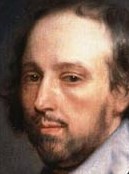
If I was a little taken aback that the eyebrow comparisons should have attracted so much attention, I have been even more surprised that a largely unknown portrait, said to be of Davenant as a young man, should have been given so much exposure. The portrait (above, photographed by Keith Barnes) hangs in the Fellows' Common Room at Davenant's old Oxford college, Lincoln, and was all but forgotten. The only accepted image of Davenant was the engraving by William Faithorne, based on a lost portrait, which adorned the title page of Davenant's Works, published in 1673:


Okay, so let's go back to Shakespeare. The subject of Shakespeare's left eye had much preoccupied me while writing Who Killed William Shakespeare? (The History Press, 2013). One thing that is clear from such portraits as the Chandos (National Portrait Gallery) and the Droeshout engraving from the First Folio is that there was something wrong with the outside corner of Shakespeare's left eye socket:

(* An x-ray of the Chandos portrait, reproduced at the bottom of this piece, illustrates the peculiarity of the left eye, the shading indicating some sort of abnormality in the left eyebrow.)
Close inspection of those images, and comparison with the Beoley skull - which will soon hit the world's media, by way of a Channel 4 documentary - suggested that the extreme corner of Shakespeare's left eye socket was damaged, probably very shortly before his death. However, that does not necessarily explain the oddity of Shakespeare's left eye as it appears in many portraits.
In several portraits thought to be of Shakespeare, the artists appear to have struggled with the left eye, making it look lower than the right eye, as if the shape of the eyebrow demanded an adjustment to the placing of the left eye - as below, in the Grafton, Janssen, and Coblitz portraits:

If these portraits appear to "drop" the left eye, in order to accommodate the deformed left eyebrow, the Soest portrait takes a different approach, squashing the left eye somewhat:
Two portraits which arguably do a better job of representing the swollen "droop" or overhang of Shakespeare's left eyebrow are the Cobbe and the Wadlow:

The fold of the overhanging left eyebrow is surely unmistakable in these images, the first trumpeted by the Shakespeare Birthplace Trust as Shakespeare, the second identified by yours truly as a portrait of Shakespeare in my paper for Goldsmiths, The Faces of Shakespeare.
The question of what was going on with Shakespeare's left eyebrow was first raised for me by a research student in biological anthropology. Perusing the images I had of the Beoley skull and assorted Shakespeare busts and portraits, including the Darmstadt death mask, the student noticed something:
... if you look at both temples on the skull, you may notice that the left temple is more "bumpy" than the right. This happens in areas where the bone needs to hold on to the soft tissue more than it normally would. If there was scar tissue in that area, that would explain why the temple bone is "bumpy" on the left and not the right. The scar tissue need not be on the skin, it could be in the muscle or facia (the stuff that holds the muscle on to the bone ...) Scar tissue often makes a depressed area in the skin so that would explain the depression behind the left eye in the portraiture. There are also a few ways this can occur developmentally with essentially the same results.


Evidently, seen through the eyes of a biological anthropologist, the "bumpy" texture of the bone above the left eye of the Beoley skull (above, from a photo by Richard Peach, 2009) corresponds with the imbalance of the fatty tissue of the eyebrows, visible on the Davenant Bust of Shakespeare (Garrick Club). A significant amount of the fatty tissue above Shakespeare's left eye was, apparently, missing, causing the bone to become "bumpy" as it sought to hold on to the skin.

The problem came when I was analysing the Davenant portraits. The Rector of Lincoln College, Oxford - who, along with the Fellows, was kind enough to give me permission to reproduce the portrait in Shakespeare's Bastard - was unconvinced that the portrait at Lincoln was of Davenant. Comparing the portrait with the Faithorne engraving (the latter post-dating the syphilis which ravaged Davenant's nose), I became fairly convinced that the chin, lips and cheekbones offered a pretty good match:

If Shakespeare's eyebrow was made to droop by a wound, the scar from which caused the fatty deposits of the eyebrow to slip, then that feature could not have been inherited. Whereas, if the drooping left eyebrow was caused by something else - one of the other ways that the loss or displacement of the fatty tissue could occur developmentally - then perhaps it was an inherited feature.
Such a drooping of the eyebrow as can be seen in the Davenant and Shakespeare portraiture is known as "ptosis". It can be an autosomal dominant inheritance, meaning that a single copy of the relevant gene is enough to cause the defect. Even if the mother had no such mutation, the fact that the father had it would mean that it was passed on to the child.
Hence my remark, in Shakespeare's Bastard, concerning the line in Ben Jonson's 1623 poem to Shakespeare in the First Folio: "Looke how the fathers face / Lives in his issue ..." When Ben Jonson wrote those words, William Davenant was already settled in London and working for the sister-in-law of Ben Jonson's patron.
Might not Davenant's drooping left eyebrow have produced in Ben Jonson a shock of recognition, that the father's face had lived on in his issue - given that Ben would have been familiar with the unusual shape of Shakespeare's left eyebrow caused, it would seem, by congenital ptosis?
(* X-ray of the Chandos portrait:)

Thursday, 28 January 2016
Breaking my Silence
Hi, folks!
Julia Robb is a Texas-based writer. I've known her - online - for a while now, and have reviewed a couple of her books, which I thoroughly enjoyed.
She's passionate about Shakespeare and has been very interested in developments since Who Killed William Shakespeare? was published in 2013.
Now she's interviewed me for her website/blog about Shakespeare, the Beoley skull, and the forthcoming Channel 4 documentary which will feature the skull. It's a pretty free and frank, no-holds-barred interview, and you can read it here:
Skull-Duggery - Julia Robb interview with Simon Stirling
So I'm no longer biting my tongue, and the truth is out there.
Meanwhile, my very first copy of Shakespeare's Bastard: The Life of Sir William Davenant is on its way to me from The History Press.
All in all, it's going to be an interesting time ...
Monday, 18 January 2016
2016: Year of the Skull and the Bastard
Belated New Year greetings!
You know, I've a feeling that it's going to be quite a year. Come April, we'll be hearing a lot about Shakespeare, it being the 400th anniversary of his death.
Before then, my latest book - Shakespeare's Bastard: The Life of Sir William Davenant - will be published by The History Press. And we can also look forward to a documentary, to be broadcast on Channel 4 here in the UK, which will show the very skull, hidden in a crypt under St Leonard's Church, Beoley, which might well be Shakespeare's (long time followers of this blog will know something about this skull already, as will anyone who's read Who Killed William Shakespeare?). So there's a lot to look forward to in just the first four months of this year.
In anticipation of which, I take great pleasure in linking the reader to a fascinating and colourful infographic on the subject of "Shakespeare in Pop Culture". This was sent to me, a little while ago now, by Roslyn Willson, and it is with great thanks to Roslyn that I include the link here.
Enjoy!
Friday, 4 December 2015
Shakespeare's Skull - Latest

It's been an interesting week, as far as "Shakespeare's Skull" goes. The crypt in which it resides was opened up, this Tuesday, and the skull scanned by archaeologists from the University of Staffordshire. All this was filmed for a Channel 4 documentary, due to be aired in April.
I didn't get to see the crypt, pictured above in a photo from circa 1939, so I didn't get to see the skull either. But here I am, going through the passages on Beoley and the skull in Shakespeare's Bastard, and I turn to an endnote I made about Anthony Wood, an Oxford antiquarian who wrote about Sir William Davenant.
Anthony Wood's close friend and benefactor was "The Great Sheldon", Ralph (1623-84), whose grandfather (also called Ralph) built the Sheldon Chapel alongside the chancel of Beoley church. It was in the elder Ralph Sheldon's funerary urn, deposited in a small ossuary adjoining the vault underneath the Sheldon Chapel, that the Reverend C.J. Langston apparently found the "veritable skull of William Shakespeare" in about 1884.
Wood attended the burial of his patron, "The Great Sheldon", which took place "in a vault situate & being under the Chappell of our Lady joining to St Leonards Church of Beoly". Presumably, then, Anthony Wood saw the crypt, under the Sheldon Chapel, in which Ralph Sheldon was laid to rest. Maybe he also saw Shakespeare's skull in there.
Although the Sheldon Chapel itself was built by the elder Ralph Sheldon in 1580, there is little to indicate when the crypt underneath it was constructed. The assumption tends to be that the chapel came first, and at a later date - before 1684, the year in which "The Great Sheldon" was buried in it - the crypt was constructed underneath the chapel. But is that necessarily the case?
The elder Ralph Sheldon appears to have built the Sheldon Chapel (or Chapel of Our Lady, as Anthony Wood seems to have thought of it) strictly for the use of his own family. It was invisible from the road but accessible from the Sheldons' manor house nearby. The Sheldons were Catholic, and no doubt wanted a chapel to worship in (the black marble altar table in the Sheldon Chapel was reputedly blessed by Pope Gregory XIII). However, the law required everyone to attend a Church of England place of worship. Cunningly, Ralph Sheldon created a chapel which would allow his Catholic family to appear to be attending an Anglican church, as the law required, without actually setting foot in an Anglican church. They attended, rather, their own Catholic chapel, alongside the Anglican chancel. Clever, eh?
But what if a priest had been celebrating Mass in the Sheldon Chapel? What if the family had been in attendance? Where would they hide in the event of a government raid?
The obvious answer would be - under the chapel. Access to the crypt is by removing a couple of steps which lead up to the Sheldon Chapel (the chapel, like the adjacent chancel, being a fair deal higher than the body of the church). Today, concrete steps lead up to the chapel, and these had to be removed to allow Arrow Media to film the skull inside the crypt this week. Previously, the steps would have been stone or, more probably, wood.
Examples exist of priest-holes which were accessed via "false" steps in staircases. A step or two would be removed, or swung on a hinge, to open up the secret entrance to the hiding place. Steps would also have to have been installed to connect the main body of the church to the Sheldon Chapel, and so it would be reasonable to expect that these stairs could have been designed to "open up", allowing access to the secret vault underneath the chapel to those who knew about it.
So, if the G-Men suddenly appeared, surrounding the church and its Catholic chapel, any priest or celebrant in the Catholic chapel could quickly disappear into the vault beneath the chapel, and the pursuivants would find the chapel empty.
The vault is large enough to hold a number of people, possibly for quite some length of time. It would need to have been somewhat more capacious than the average priest-hole if it might have to accommodate several celebrants, plus a priest, all at once. Only later did the readymade crypt become a handy burial vault for the family that built it.

A gap in the wall of the crypt opens into the little ossuary adjoining it - the "bone-house" in which the skull which looks suspiciously like it might be Shakespeare's was "found". This can be thought of as an additional hiding place - a cramped "priest-hole" of last resort, in which a small priest could hide if the entrance to the vault was discovered. It could also have been a repository for all that Catholic paraphernalia (rosaries, vestments, prayer books, candles, etc.) which could not be safely hidden anywhere else. Everything needed for an illicit Catholic Mass in the Sheldon Chapel would be stored directly underneath it, and if it all went wrong, the priest - and some of his flock - could hide in the vault till the priest-hunters had gone.
I suspect, then, that the crypt and the ossuary were constructed at the same time as the chapel above, but not as a burial vault. They were hiding places.
Shakespeare's head, collected after his sudden death - probably by his first love, Anne Whately, whose relatives were supported by the Sheldons of Beoley, and whose family name appears in various parts of the church, including on a churchwardens' chest in the Sheldon Chapel - would have been taken to Beoley church because there was a safe hiding place under the Sheldon Chapel. It would have joined those priestly items necessary to hold a Mass in the chapel above.
There could have been no safer or more sacred a place for such an extraordinary relic as the head of the Catholic martyr, William Shakespeare.
Tuesday, 24 November 2015
I'm Not Going to Say "I told you so ..."
More than three years after The King Arthur Conspiracy was published, the British media have been all over this story (representative sample from The Guardian).
Apparently, a research team from the University of Reading have concluded that the monks of Glastonbury made up the story that King Arthur was buried there, and an awful lot more besides.
I said as much in The King Arthur Conspiracy (and, incidentally, in The Grail, published earlier this year). So - vindicated!
Wonder what else the media will suddenly discover in the coming months, that I also wrote about a few years back ...
(Watch this space)
Heads Up: Shakespeare's Bastard
Just came across this on the Foyle's website.
Shakespeare's Bastard: The Life of Sir William Davenant by Yours Truly is now available for pre-order. And it'll be published on my birthday!
That makes me strangely happy.
Subscribe to:
Posts (Atom)