Hello, Happy New Year, and welcome!
It had occurred to me to write up a review of 2014 and the various things that happened last year - from publishing my first university paper on The Faces of Shakespeare to the publication, in September, of Naming the Goddess, in which I have an essay (tweet received this morning from Michigan: 'Loved your essay in "Naming the Goddess"! Great perspective.:)', plus appearances at Stratford Literary Festival and the Tree House Bookshop, lecturing at Worcester University and being a tour guide in Stratford-upon-Avon, completing The Grail; Relic of an Ancient Religion and writing Shakespeare's Son ('The Life of Sir William Davenant'), and so on. But I didn't get round to it.
Instead, I'm going to preen myself a little over this, which my wife found online a day or two ago. Seems there's to be a rather interesting-looking course on the 'Renaissance of the Sacred Feminine', to be held at Avebury in Wiltshire (good location!) this coming August. Details can be found here.
If you click on the link and scroll down to the bottom section - 'Avebury/Wiltshire Reading List' - you'll see that the last entry concerns my King Arthur Conspiracy book. Alternatively, I'll save you the bother by copying what they wrote:
The King Arthur Conspiracy: How a Scottish prince became a mythical hero
By Simon Andrew Stirling
2012
First discovered during the Scotland adventure, this book is an indispensable read for anyone interested in the Arthur/Merlin/Avalon motif. All the latest research. It will expand your view beyond the emphasis on Glastonbury and Tintagel.
Now, seeing that made me feel really chuffed. It also made me want to get in touch with the organisers and tell them that, actually, all the latest research is probably best found in The Grail, due out in March, but that it was very kind of them to say those things about The King Arthur Conspiracy (and might help with a few book sales), and if there was anything I could do to contribute to their intriguing course in August they had only to ask.
Didn't get round to doing that, either. Although there's still time.
For the meantime, we're holding our breaths and crossing our fingers over the Beoley skull. With any luck, there'll be some scientific investigation of that particular item before too long. Maybe even a TV documentary. I'll keep you posted.
And my Davenant book is coming on apace. New discoveries about Shakespeare's relationship with Jane Davenant. All good clean fun. The manuscript's due to hit the editor's desk at the start of June.
There's another project in the wings, which I'll mention more about if things keep going smoothly. All in all, 2015 has a very exciting feel about it. I hope yours does, too.
TTFN!
Showing posts with label Shakespeare's Son. Show all posts
Showing posts with label Shakespeare's Son. Show all posts
Sunday, 4 January 2015

Monday, 1 December 2014
THE GRAIL ... Coming Soon!!!

Publication in March 2015.
Looking good, isn't it?
I've set up a Facebook page for the new book (click on "Facebook page" to go straight to it) and I'll keep you updated as the launch date draws nearer.
Meantime, work proceeds on Shakespeare's Son - my "Life of Sir William Davenant" - which has been keeping me pretty busy. And hoping to have some interesting news pretty soon regarding Shakespeare's skull.
Plenty more to come, folks!
Sunday, 17 August 2014
Alyth, the Scene of Arthur's Last Battle
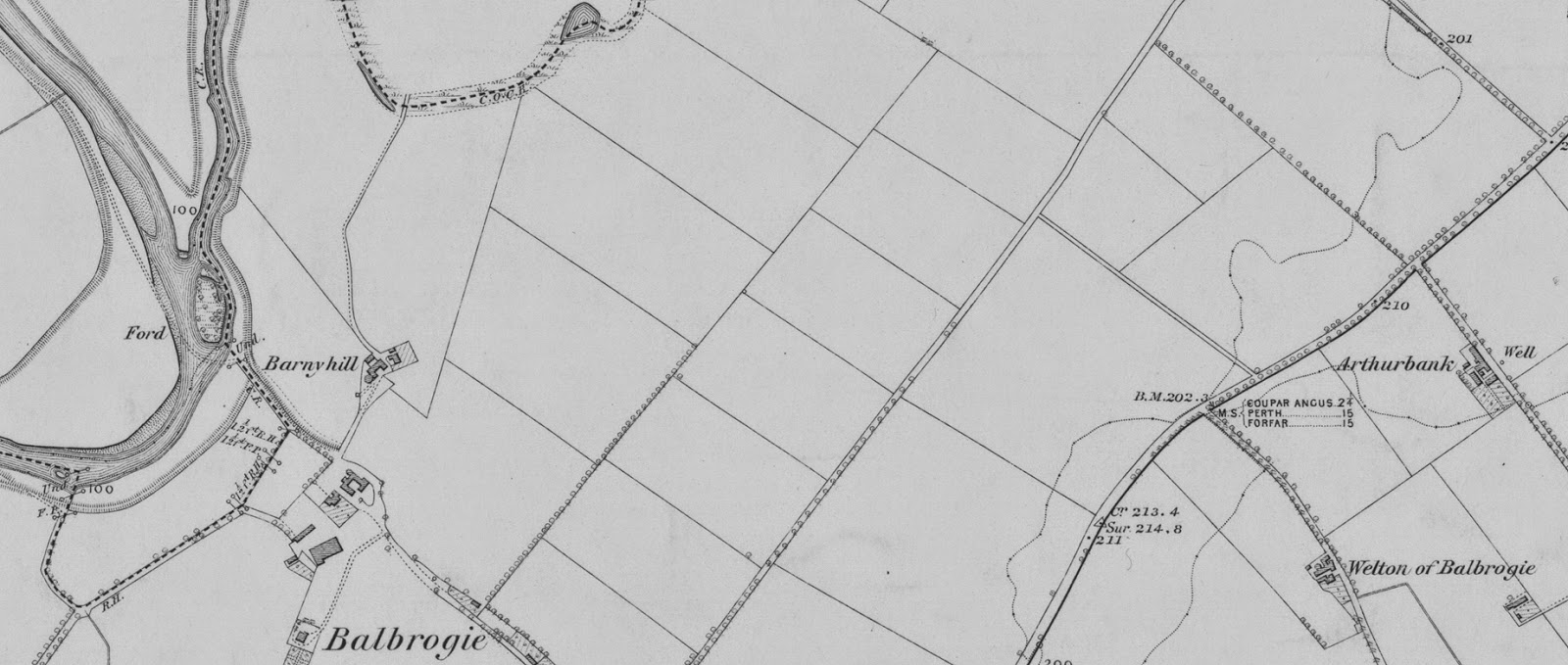
While I work on Shakespeare's Son - my biography of Sir William Davenant, a man of whom I'm becoming increasingly fond - The Grail continues to make its way through the publishing process, courtesy of Moon Books. So, by way of a sneak preview, in this post I shall offer up some of the evidence for the location of Arthur's last battle.
The Battle of Circenn
You probably think Arthur's last battle was fought at a place called "Camlann". I've been unable to find any reference to that place-name before the Middle Ages. The very earliest mentions of anyone called Arthur in the records indicate that he died in a battle fought in Angus, Scotland.
Adomnan of Iona's Life of Columba (circa 697) tells us that Artur son of Aedan was present when his father was "ordained" king of the Scots by St Columba in AD 574. The saint predicted the fates of Aedan's sons, announcing that Artur would "fall in battle, slain by enemies". Adomnan assured his readers that this prophecy came true when Artur and at least one of his brothers was killed in a "battle of the Miathi".
The Miathi, or Maeatae, were a Pictish tribe: essentially, they held the low-lying lands to the south and east of the Highland massif. Another Latinate term for these people was Verturiones.
The Irish annals, which drew at least some of their information from the records kept by Columba's monks on the Isle of Iona, specify that Artur son of Aedan died in a "battle of Circenn". This refers to the Pictish province which was roughly contiguous with today's Angus and the Mearns. The term Circenn combined the Gaelic cir, meaning a "comb" or "crest", and cenn, "heads". Circenn, then, was the land of the Comb-heads. This tells us that the Miathi Picts modelled their appearance on their totem beast, the boar (rather like their compatriots in the Orkneys, the Orcoi, from orc - a young boar). Indeed, it is possible that the Latinate name for the Verturiones tribe combines verres and turio and indicates the "offshoots" or "offspring" of the "boar", while the very term "Pict" (variant, "Pecti", "Pecht") quite possibly derived from the Latin pecten, a "comb".
Now, let's look at "Camlann" - the traditional name for Arthur's last battle. Its first appearance in the records comes in an entry interpolated into the Welsh Annals, where it refers to a gueith cam lann or "strife of cam lann". By the time this came to be written down, the region in which Artur son of Aedan died was speaking a version of Northumbrian Old English which became the dialect known as Lowland Scots. In that dialect, cam lann would mean "comb land".
In other words, "Camlann" is merely an anglicised version of the Gaelic Circenn, the land of the "Comb-heads" in which the first Arthur on record fell in a cataclysmic battle.
Culhwch and Olwen
One of the oldest of the Welsh (i.e. British) tales to feature Arthur is that of Culhwch ac Olwen. It forms a sort of mythologised, potted account of Arthur's career, culminating in the desperate and bloody hunt for a king who - for his sins - was turned into a boar. This hunt begins with a violent amphibious landing, at a site which can be identified as Cruden Bay, on the Aberdeenshire coast, after which Arthur is met by the "saints of Ireland" who "besought his protection". The dreadful Boar-King is challenged and chased from Esgeir Oerfel, the "Cold Ridge" of the Grampians, the Boar-King making his way across country towards Llwch Tawy (Loch Tay) before he is intercepted by Arthur and his men and driven into a river.
In The King Arthur Conspiracy I identified the treacherous Boar-King as Morgan the Wealthy, a renegade British prince who abducted Arthur's wife, Gwenhwyfar, and escaped into the land of the Miathi Picts (his bolt hole appears to have been the fortified Hill of Tillymorgan in Strathbogie). The site where Morgan finally came to grief is marked by the "Morganstone" on the west bank of the River Ericht, a short distance to the west of the Hill of Alyth in the great vale of Strathmore in Angus.
Arthurian Connections with Alyth
Before we proceed, let us consider some ancient references to Arthur and his family in the context of Alyth and its immediate vicinity.
In addition to having a son named Artur or Artuir, King Aedan of the Scots had a daughter called Muirgein. According to Whitley Stokes, editing and translating the Martyrology of a 9th-century Irish monk called Oengus, Muirgein daughter of Aedan was born "in Bealach Gabrain".
The inability of certain scholars to find a "Bealach Gabrain" in Scotland has led some to argue that Muirgein daughter of Aedan was utterly unconnected with Artur son of Aedan. But place-names evolve. The Gaelic term bealach, meaning a "pass" or "gorge", usually appears as "Balloch" on today's maps. There is a "Balloch" which runs along the feet of Barry Hill and the adjacent Hill of Alyth in Strathmore.
Furthermore, this "Balloch" or bealach was in a region named after the grandfather of Artur and Muirgein. Gabran was the father of Aedan. He ruled the Scots for twenty years until his death in about AD 559 and gave his name to the region of Gowrie (a corruption of Gabran). The "Balloch" near Alyth was in Gabran's land (Gabrain) and lies close to the town of Blairgowrie, which also recalls the name of Arthur's grandfather. The "Balloch" at the foot of the Hill of Alyth was almost certainly the "Bealach Gabrain" or "pass of Gowrie" where Arthur's (half-)sister, Muirgein daughter of Aedan mac Gabrain, was born. To pretend that the Balloch of Gowrie could not have been "Bealach Gabrain" because they are not spelled the same way these days is tantamount to claiming that Londinium and London could not have been the same place.
So Arthur's sister, Muirgein (latterly, Morgan le Fay), was born near Alyth. Writing in about 1527, the Scottish historian Hector Boece also indicated that Arthur's wife was buried at Meigle, which is just a mile or two south of Alyth. Hector Boece's local tradition recalled Gwenhwyfar as Vanora (via Guanora) and claimed that she had been held hostage in the Iron Age hill-fort atop Barry Hill, adjacent to the Hill of Alyth, before she was executed and buried in what is now the kirkyard at Meigle. A carved Pictish standing stone, now on display at the Meigle museum, reputedly depicts the execution or burial of Arthur's wife.
Y Gododdin
One of the best sources of information about Arthur's last battle is the ancient epic, Y Gododdin. This was composed and sung by Aneirin, a British bard of the Old North, and can be dated to circa AD 600 (the date of Arthur's last battle is given in the Irish annals as, variously, AD 594 and 596).
Unfortunately, the relevance of Aneirin's elegiac tribute to the warriors of Lothian (the "Gododdin") has been missed by scholars who want to believe that the poem bemoans the destruction of a British war-band from the Edinburgh area which had the misfortune to be wiped out at a mythical battle fought at Catterick in North Yorkshire. No evidence exists that any such battle was fought. The Angles (forerunners of the English) preferred not to recollect their defeats but were happy to remember, and to boast about, their victories. If the Angles of Northumbria had indeed obliterated a British band of heroes from Lothian at Catterick, we might assume that they would have remembered doing so. And no scholar has yet explained the presence of "Irishman and Picts" at this imaginary battle in Anglian territory.
A verse or two of Y G[ododdin, added at a later date than the original composition, described a battle fought in Scotland (Strathcarron) in AD 642 and the death in that battle of a Scottish king who just happened to be a nephew of Artur son of Aedan. This interpolation does at least suggest that the subject of the original poem was a battle fought in roughly the same area (Scotland) by the family of Artur and his father Aedan. The Y Gododdin poem also mentions various famous warriors who appear in the early accounts of Arthur's career and who were contemporary with Artur son of Aedan.
One surviving version of Y Gododdin even mentions Artur/Artuir by name:
Gochore brein du ar uur
caer ceni bei ef Arthur
rug ciuin uerthi ig disur ...
Confused by the misidentification of the battle sung about by Aneirin in Y Gododdin, and the assumption that Arthur himself could not have been present at that battle, scholars have persistently mistranslated this verse - mostly in an attempt to render the second half of the second line, "He was no Arthur". But Aneirin's verse should properly be translated thus:
Black ravens [warriors] sang in praise of the hero [Welsh, arwr]
of Circenn [transliterated into Welsh as "caer ceni"]. He blamed Arthur;
the dogs cursed in return for our wailing/lamentation ...
Aneirin indicated, in his Y Gododdin elegy, precisely where the final battle took place:
Eil with gwelydeint amallet
y gat veirch ae seirch greulet
bit en anysgoget bit get ...
Which translates as:
Again they came into view around the alled,
the battle-horses and the bloody armour,
still steadfast, still united ...
The "alled" was Aneirin's Welsh-language attempt at the Gaelic Allaid - also Ailt - or the Hill of Alyth.
Breuddwyd Rhonabwy
The extraordinary medieval Welsh tale of The Dream of Rhonabwy actually provides a description of the scene in the hours before Arthur's last battle was fought. The visionary seer, Rhonabwy, finds himself crossing a great plain with a river running through it (Strathmore). He is met by a character call Iddog, "Churn of Britain", who admits that it was he who caused the cataclysmic "battle of Camlan" by betraying Arthur. In company with Iddog, Rhonabwy approaches the "Ford of the Cross" (Rhyd-y-Groes) on the river. A great army is encamped on either side of the road and Arthur is seated on a little flat islet in the river, beside the ford.
The topography precisely matches the detail from a 19th-century Ordnance Survey map of the area around Alyth seen at the top of this post. On the right-hand side of the detail is the ridge known as Arthurbank, which lies along the River Isla, opposite the junction of the River Ericht with the River Isla (a few miles down the Ericht from the site of the Morganstone). A little flat islet lies in the River Isla, close to the Arthurbank shore, and a ford runs alongside this little islet, exactly as described in the Welsh account of Rhonabwy's dream.
Aneirin also mentioned this ford in his Y Gododdin poem as rhyd benclwyd - the "ford" of the "grey" or "holy mount". There is, indeed, a Greymount marked on the map, a short distance to the north of the ford on the Isla. In his Agriculture of Perthshire, published in 1799, the Rev. Dr Robertson described the discovery of a "large Druidical temple" at Coupar Grange, adjacent to this ford. A standing stone found in this "temple" would no doubt have been rebranded a "cross" by the early Christians, so that the ford across the Isla, beside the little flat islet, would have become known as the Ford of the Cross (Rhyd-y-Groes), as described in The Dream of Rhonabwy, or the "Ford of the Grey/Holy Mount" (rhyd benclwyd) as described by Aneirin.
Until the late 18th century, an Arthurstone stood at the south-eastern edge of the Arthurbank ridge (its presence is still marked on the map). This Arthurstone corresponds to the Morganstone, a few miles away up the River Ericht, and marks the spot where Arthur fell in his battle with the Boar-King of the Miathi Picts in the land of the "crested" Comb-heads, Camlann.
The Head of the Valley of Sorrow
After the battle, Arthur's wife Gwenhwyfar was executed and buried only a mile or so away at Meigle. The legend of Culhwch and Olwen (which, interestingly, features a treacherous individual identified as Grugyn, who also appears in Aneirin's Y Gododdin) tells us that, after the battle at the river with the dangerous Boar-King, Arthur and his heroes once more "set out for the North" to overcome a fearsome witch. She was found inside a cave at Penn Nant Gofid - the "Head of the Valley of Sorrow"- on "the confines of Hell" (which we can interpret as the edge of the territory controlled by those boar-like Miathi Picts). The Welsh gofid ("sorrow/trouble/affiction/grief") appears to have been something of a pun, for another Welsh word for sorrow or grief is alaeth (compare Ailt, Allaid and Alyth, the "Head of the Valley of Alyth" being the very hill on which Arthur's wife is rumoured to have been held prisoner before her execution and burial nearby at Meigle).
In the Welsh tale, this witch is known as Orddu (that is, Gorddu - "Very Black"). A similar legend from the Isle of Mull, whose Arthurian associations have been overlooked for far too long, names the troublesome wife as Corr-dhu ("Black-Crane").
We might also note that the 9th-century Welsh monk known as Nennius described a "wonder" of Scotland in the form of "a valley in Angus, in which shouting is heard every Monday night; Glend Ailbe is its name, and it is not known who makes this noise."
Nennius's Glend Ailbe seems to be a corruption of the Gaelic word for a valley (glen) and the River Isla, or perhaps the Allaid or Hill of Alyth, which dominates the vale of Strathmore. The mysterious shouting in this "Valley of Sorrow" was reputedly heard ever Monday night. And we know from Aneirin's eye-witness account of Arthur's last battle that it came to an end on a Monday.
This is just some of the evidence for Arthur having fallen in the vicinity of Alyth. There is plenty more to come in The Grail; Relic of an Ancient Religion - including descriptions of the Pictish symbol stones, found close to the site of that battle, which actually depict the Grail in use!
I'll let you know when the book is about to be published.
Wednesday, 11 June 2014
How to Start a Civil War

The English Civil War.
More than anything, I've been eager to understand why it happened.
Naturally, there were large-scale issues - such as the feeling, among many fanatics, that the English Reformation in the 16th century simply hadn't gone far enough. The Church of England, as it was established under Elizabeth I, was really a sort of State broadcasting service. It was neither too Catholic nor too Calvinist. The more zealous Protestants wanted something far more extreme.
But that doesn't explain how the country slid into military conflict. To understand that, we might look at just one small example of contemporary politicking.
In January 1644, a ship sailing from Dunkirk to Spain ran aground on the south coast of England. Local troops seized what they could, including various "Popish pictures and superstitious Imagery". One of these was a large picture which, it was said, depicted the Pope offering a sceptre to King Charles I of England, who declined it, offering it instead to his queen, Henrietta Maria, a Catholic. The picture, therefore, showed that "Pope and Queene share the Sceptre of England between them". It was a comment on King Charles I, who was then at war with his Parliament: the King was under his wife's thumb, and both of them were in hock to the Bishop of Rome.
No one seems to have asked themselves why such an image was on its way to an obscure Spanish church. But one pamphleteer did enter the fray, pointing out that the figure supposedly representing Charles I was wearing the costume of an ancient Roman captain; that the "Pope" was clearly an ordinary bishop; that the distinctive spire in the background belonged to the cathedral of Cologne, and that the subject of the painting was quite obviously an episode from the life of St Ursula, whose martyrdom was depicted in the background.
A few were convinced. But others continued to insist that the captured painting showed nothing less than the Pope in league with King Charles, who was further to be damned for listening too much to his French wife. In short, it didn't matter what evidence was brought forth: the hard-liners saw what they wanted to see, and that was that.
Such things happen in febrile times. Events are interpreted, not on the basis of fact or evidence, but on the basis of preconceived prejudices. Once people are prepared instantly to believe that a painting of St Ursula is really a painting of the English king being wooed by the Pope and handing power to his queen, then all hope of reasonable debate is lost.
It's no coincidence that these things happened at a time when the printed word was being distributed like never before. There is a similarity with our own times - the internet is not unlike the pamphleteering activity of the 17th century. Anyone who has an opinion can voice it. Many are using the opportunity deliberately to misinform others and incite political agitation.
We're fast heading into similar territory as that in which a painting of a sacred subject can become something altogether different - an indictment of the supposed faults of an English king. Now, as then, people are filtering their interpretations of events through their own prejudices. Whenever something happens, the facts are immediately "spun". The event, and the motives of those concerned, are instantaneously reinterpreted through a veritable Babel of claim and counterclaim. The result is a rush to judgement, as people too easily swallow the interpretation which suits their prejudices. Pointing out the facts of the matter becomes a waste of time. Battle lines have been drawn, long before any evidence actually comes to light.
The earliest known accounts of the Flood indicate that the gods decided to punish mankind because we had become "noisy".
Well, we're becoming noisy again. Things got noisy in the early 1640s, and that led to a bloody civil war, the execution of a king, and a government of fanatics, which was nothing short of a military dictatorship.
So, there you have it: the English Civil War was caused, as much as anything, by people's willingness to believe nonsense rather than look at the facts.
If history teaches us anything, it's that when people prefer to be noisy than to take a breath, examine the evidence and come to a sensible, informed and considered conclusion, then something like a civil war can't be far away.
Subscribe to:
Posts (Atom)