Just been told that an interview with me is now up on the PaganPages.org website.
So, with thanks to Mabh Savage, I give you ... The Pagan Pages Interview with Author Simon Stirling. I think it's a good one.
Toodle-pip!
Showing posts with label Artuir mac Aedain. Show all posts
Showing posts with label Artuir mac Aedain. Show all posts
Sunday, 2 November 2014

Sunday, 17 August 2014
Alyth, the Scene of Arthur's Last Battle
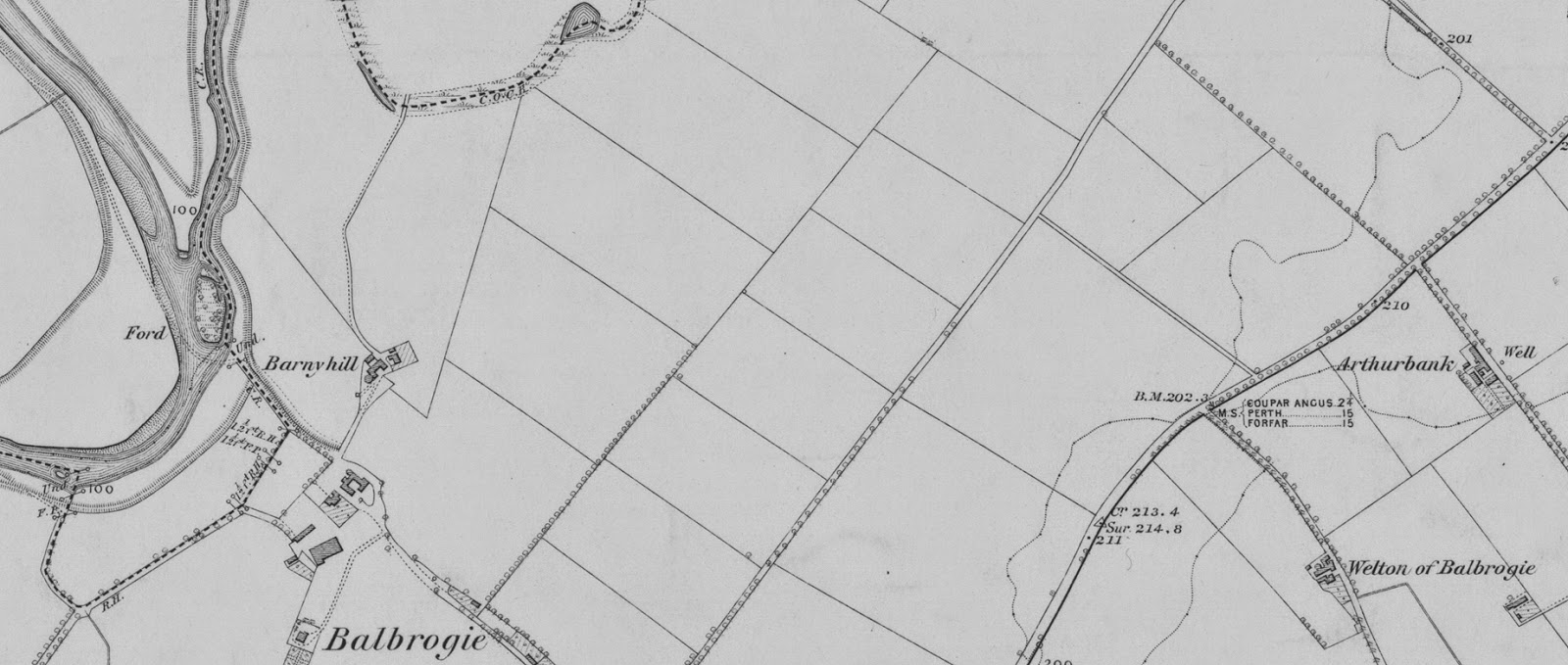
While I work on Shakespeare's Son - my biography of Sir William Davenant, a man of whom I'm becoming increasingly fond - The Grail continues to make its way through the publishing process, courtesy of Moon Books. So, by way of a sneak preview, in this post I shall offer up some of the evidence for the location of Arthur's last battle.
The Battle of Circenn
You probably think Arthur's last battle was fought at a place called "Camlann". I've been unable to find any reference to that place-name before the Middle Ages. The very earliest mentions of anyone called Arthur in the records indicate that he died in a battle fought in Angus, Scotland.
Adomnan of Iona's Life of Columba (circa 697) tells us that Artur son of Aedan was present when his father was "ordained" king of the Scots by St Columba in AD 574. The saint predicted the fates of Aedan's sons, announcing that Artur would "fall in battle, slain by enemies". Adomnan assured his readers that this prophecy came true when Artur and at least one of his brothers was killed in a "battle of the Miathi".
The Miathi, or Maeatae, were a Pictish tribe: essentially, they held the low-lying lands to the south and east of the Highland massif. Another Latinate term for these people was Verturiones.
The Irish annals, which drew at least some of their information from the records kept by Columba's monks on the Isle of Iona, specify that Artur son of Aedan died in a "battle of Circenn". This refers to the Pictish province which was roughly contiguous with today's Angus and the Mearns. The term Circenn combined the Gaelic cir, meaning a "comb" or "crest", and cenn, "heads". Circenn, then, was the land of the Comb-heads. This tells us that the Miathi Picts modelled their appearance on their totem beast, the boar (rather like their compatriots in the Orkneys, the Orcoi, from orc - a young boar). Indeed, it is possible that the Latinate name for the Verturiones tribe combines verres and turio and indicates the "offshoots" or "offspring" of the "boar", while the very term "Pict" (variant, "Pecti", "Pecht") quite possibly derived from the Latin pecten, a "comb".
Now, let's look at "Camlann" - the traditional name for Arthur's last battle. Its first appearance in the records comes in an entry interpolated into the Welsh Annals, where it refers to a gueith cam lann or "strife of cam lann". By the time this came to be written down, the region in which Artur son of Aedan died was speaking a version of Northumbrian Old English which became the dialect known as Lowland Scots. In that dialect, cam lann would mean "comb land".
In other words, "Camlann" is merely an anglicised version of the Gaelic Circenn, the land of the "Comb-heads" in which the first Arthur on record fell in a cataclysmic battle.
Culhwch and Olwen
One of the oldest of the Welsh (i.e. British) tales to feature Arthur is that of Culhwch ac Olwen. It forms a sort of mythologised, potted account of Arthur's career, culminating in the desperate and bloody hunt for a king who - for his sins - was turned into a boar. This hunt begins with a violent amphibious landing, at a site which can be identified as Cruden Bay, on the Aberdeenshire coast, after which Arthur is met by the "saints of Ireland" who "besought his protection". The dreadful Boar-King is challenged and chased from Esgeir Oerfel, the "Cold Ridge" of the Grampians, the Boar-King making his way across country towards Llwch Tawy (Loch Tay) before he is intercepted by Arthur and his men and driven into a river.
In The King Arthur Conspiracy I identified the treacherous Boar-King as Morgan the Wealthy, a renegade British prince who abducted Arthur's wife, Gwenhwyfar, and escaped into the land of the Miathi Picts (his bolt hole appears to have been the fortified Hill of Tillymorgan in Strathbogie). The site where Morgan finally came to grief is marked by the "Morganstone" on the west bank of the River Ericht, a short distance to the west of the Hill of Alyth in the great vale of Strathmore in Angus.
Arthurian Connections with Alyth
Before we proceed, let us consider some ancient references to Arthur and his family in the context of Alyth and its immediate vicinity.
In addition to having a son named Artur or Artuir, King Aedan of the Scots had a daughter called Muirgein. According to Whitley Stokes, editing and translating the Martyrology of a 9th-century Irish monk called Oengus, Muirgein daughter of Aedan was born "in Bealach Gabrain".
The inability of certain scholars to find a "Bealach Gabrain" in Scotland has led some to argue that Muirgein daughter of Aedan was utterly unconnected with Artur son of Aedan. But place-names evolve. The Gaelic term bealach, meaning a "pass" or "gorge", usually appears as "Balloch" on today's maps. There is a "Balloch" which runs along the feet of Barry Hill and the adjacent Hill of Alyth in Strathmore.
Furthermore, this "Balloch" or bealach was in a region named after the grandfather of Artur and Muirgein. Gabran was the father of Aedan. He ruled the Scots for twenty years until his death in about AD 559 and gave his name to the region of Gowrie (a corruption of Gabran). The "Balloch" near Alyth was in Gabran's land (Gabrain) and lies close to the town of Blairgowrie, which also recalls the name of Arthur's grandfather. The "Balloch" at the foot of the Hill of Alyth was almost certainly the "Bealach Gabrain" or "pass of Gowrie" where Arthur's (half-)sister, Muirgein daughter of Aedan mac Gabrain, was born. To pretend that the Balloch of Gowrie could not have been "Bealach Gabrain" because they are not spelled the same way these days is tantamount to claiming that Londinium and London could not have been the same place.
So Arthur's sister, Muirgein (latterly, Morgan le Fay), was born near Alyth. Writing in about 1527, the Scottish historian Hector Boece also indicated that Arthur's wife was buried at Meigle, which is just a mile or two south of Alyth. Hector Boece's local tradition recalled Gwenhwyfar as Vanora (via Guanora) and claimed that she had been held hostage in the Iron Age hill-fort atop Barry Hill, adjacent to the Hill of Alyth, before she was executed and buried in what is now the kirkyard at Meigle. A carved Pictish standing stone, now on display at the Meigle museum, reputedly depicts the execution or burial of Arthur's wife.
Y Gododdin
One of the best sources of information about Arthur's last battle is the ancient epic, Y Gododdin. This was composed and sung by Aneirin, a British bard of the Old North, and can be dated to circa AD 600 (the date of Arthur's last battle is given in the Irish annals as, variously, AD 594 and 596).
Unfortunately, the relevance of Aneirin's elegiac tribute to the warriors of Lothian (the "Gododdin") has been missed by scholars who want to believe that the poem bemoans the destruction of a British war-band from the Edinburgh area which had the misfortune to be wiped out at a mythical battle fought at Catterick in North Yorkshire. No evidence exists that any such battle was fought. The Angles (forerunners of the English) preferred not to recollect their defeats but were happy to remember, and to boast about, their victories. If the Angles of Northumbria had indeed obliterated a British band of heroes from Lothian at Catterick, we might assume that they would have remembered doing so. And no scholar has yet explained the presence of "Irishman and Picts" at this imaginary battle in Anglian territory.
A verse or two of Y G[ododdin, added at a later date than the original composition, described a battle fought in Scotland (Strathcarron) in AD 642 and the death in that battle of a Scottish king who just happened to be a nephew of Artur son of Aedan. This interpolation does at least suggest that the subject of the original poem was a battle fought in roughly the same area (Scotland) by the family of Artur and his father Aedan. The Y Gododdin poem also mentions various famous warriors who appear in the early accounts of Arthur's career and who were contemporary with Artur son of Aedan.
One surviving version of Y Gododdin even mentions Artur/Artuir by name:
Gochore brein du ar uur
caer ceni bei ef Arthur
rug ciuin uerthi ig disur ...
Confused by the misidentification of the battle sung about by Aneirin in Y Gododdin, and the assumption that Arthur himself could not have been present at that battle, scholars have persistently mistranslated this verse - mostly in an attempt to render the second half of the second line, "He was no Arthur". But Aneirin's verse should properly be translated thus:
Black ravens [warriors] sang in praise of the hero [Welsh, arwr]
of Circenn [transliterated into Welsh as "caer ceni"]. He blamed Arthur;
the dogs cursed in return for our wailing/lamentation ...
Aneirin indicated, in his Y Gododdin elegy, precisely where the final battle took place:
Eil with gwelydeint amallet
y gat veirch ae seirch greulet
bit en anysgoget bit get ...
Which translates as:
Again they came into view around the alled,
the battle-horses and the bloody armour,
still steadfast, still united ...
The "alled" was Aneirin's Welsh-language attempt at the Gaelic Allaid - also Ailt - or the Hill of Alyth.
Breuddwyd Rhonabwy
The extraordinary medieval Welsh tale of The Dream of Rhonabwy actually provides a description of the scene in the hours before Arthur's last battle was fought. The visionary seer, Rhonabwy, finds himself crossing a great plain with a river running through it (Strathmore). He is met by a character call Iddog, "Churn of Britain", who admits that it was he who caused the cataclysmic "battle of Camlan" by betraying Arthur. In company with Iddog, Rhonabwy approaches the "Ford of the Cross" (Rhyd-y-Groes) on the river. A great army is encamped on either side of the road and Arthur is seated on a little flat islet in the river, beside the ford.
The topography precisely matches the detail from a 19th-century Ordnance Survey map of the area around Alyth seen at the top of this post. On the right-hand side of the detail is the ridge known as Arthurbank, which lies along the River Isla, opposite the junction of the River Ericht with the River Isla (a few miles down the Ericht from the site of the Morganstone). A little flat islet lies in the River Isla, close to the Arthurbank shore, and a ford runs alongside this little islet, exactly as described in the Welsh account of Rhonabwy's dream.
Aneirin also mentioned this ford in his Y Gododdin poem as rhyd benclwyd - the "ford" of the "grey" or "holy mount". There is, indeed, a Greymount marked on the map, a short distance to the north of the ford on the Isla. In his Agriculture of Perthshire, published in 1799, the Rev. Dr Robertson described the discovery of a "large Druidical temple" at Coupar Grange, adjacent to this ford. A standing stone found in this "temple" would no doubt have been rebranded a "cross" by the early Christians, so that the ford across the Isla, beside the little flat islet, would have become known as the Ford of the Cross (Rhyd-y-Groes), as described in The Dream of Rhonabwy, or the "Ford of the Grey/Holy Mount" (rhyd benclwyd) as described by Aneirin.
Until the late 18th century, an Arthurstone stood at the south-eastern edge of the Arthurbank ridge (its presence is still marked on the map). This Arthurstone corresponds to the Morganstone, a few miles away up the River Ericht, and marks the spot where Arthur fell in his battle with the Boar-King of the Miathi Picts in the land of the "crested" Comb-heads, Camlann.
The Head of the Valley of Sorrow
After the battle, Arthur's wife Gwenhwyfar was executed and buried only a mile or so away at Meigle. The legend of Culhwch and Olwen (which, interestingly, features a treacherous individual identified as Grugyn, who also appears in Aneirin's Y Gododdin) tells us that, after the battle at the river with the dangerous Boar-King, Arthur and his heroes once more "set out for the North" to overcome a fearsome witch. She was found inside a cave at Penn Nant Gofid - the "Head of the Valley of Sorrow"- on "the confines of Hell" (which we can interpret as the edge of the territory controlled by those boar-like Miathi Picts). The Welsh gofid ("sorrow/trouble/affiction/grief") appears to have been something of a pun, for another Welsh word for sorrow or grief is alaeth (compare Ailt, Allaid and Alyth, the "Head of the Valley of Alyth" being the very hill on which Arthur's wife is rumoured to have been held prisoner before her execution and burial nearby at Meigle).
In the Welsh tale, this witch is known as Orddu (that is, Gorddu - "Very Black"). A similar legend from the Isle of Mull, whose Arthurian associations have been overlooked for far too long, names the troublesome wife as Corr-dhu ("Black-Crane").
We might also note that the 9th-century Welsh monk known as Nennius described a "wonder" of Scotland in the form of "a valley in Angus, in which shouting is heard every Monday night; Glend Ailbe is its name, and it is not known who makes this noise."
Nennius's Glend Ailbe seems to be a corruption of the Gaelic word for a valley (glen) and the River Isla, or perhaps the Allaid or Hill of Alyth, which dominates the vale of Strathmore. The mysterious shouting in this "Valley of Sorrow" was reputedly heard ever Monday night. And we know from Aneirin's eye-witness account of Arthur's last battle that it came to an end on a Monday.
This is just some of the evidence for Arthur having fallen in the vicinity of Alyth. There is plenty more to come in The Grail; Relic of an Ancient Religion - including descriptions of the Pictish symbol stones, found close to the site of that battle, which actually depict the Grail in use!
I'll let you know when the book is about to be published.
Monday, 2 June 2014
The Meaning of "Camlann"
I received a message from Moon Books today, telling me that the copyedited manuscript of The Grail; Relic of an Ancient Religion is ready for me to check.
It seems unlikely that the book will be available before the Scottish independence referendum in September. I'll be keeping a close eye on the referendum: the vote takes place the day before my 12th wedding anniversary, and having got married on the Isle of Iona to a woman who is half-Scottish, as well as having gone to university in Glasgow, my sympathies lie very much with the "YES" campaign.
I was also interested to note that Le Monde published this piece, indicating that the pro-independence campaign is gaining ground. The reporter had been in Alyth, Perthshire, to follow the debate. Alyth, as I revealed in The King Arthur Conspiracy, is where Arthur fought his last battle.
How do I know this? Lots of reasons, not least of all the fact that the place is name checked in a contemporary poem of the battle.
But wasn't Arthur's last battle fought at a place called Camlan?
Well, for a long while I wasn't so sure. Now, though, I know that it was - sort of - and I explain why in my forthcoming book on The Grail. But as that may not be out before the referendum, I hereby present this information as a gift to the "YES" campaign and in honour of a warrior who gave his life fighting for Scottish (and British) independence.
Many commentators refuse to accept that the place-name "Camlan" isn't Welsh. The fact that Camlan is the Gaelic name for the old Roman fortifications at Camelon, near Falkirk in central Scotland, means nothing to them. Arthur's "Camlan" was Welsh, and that's all it could have been.
Very silly - and utterly useless, in terms of trying to track down the site of that all-important battle. If it was a Welsh place-name, it would have meant something like "Crooked Valley", which really doesn't help us very much.
The first literary reference to "Camlann" comes in the Annales Cambriae ("Welsh Annals") which mention Gueith cam lann - the "Strife of Camlann". However, that reference cannot be traced back to an earlier date than the 10th century, hundreds of years after the time of Arthur. The contemporary sources make no mention of "Camlann", and so it may be that the name didn't come into use until many years after Arthur's last battle was fought there.
The earliest literary reference to anyone called Arthur concerns an individual named Artur mac Aedain. He was a son of Aedan mac Gabrain, who was "ordained" King of the Scots by St Columba in 574. Accounts of the ordination ceremony indicate that Arthur son of Aedan was present on that occasion, and that St Columba predicted that Arthur would not succeed his father to the Scottish throne but would "fall in battle, slain by enemies."
Those same accounts tell us that Columba's prophecy came true: Artur mac Aedain died in a "battle of the Miathi", which means that he was killed fighting the Picts of central Scotland.
The Irish Annals, which were compiled from notes made by the monks of Iona, inform us that the first recorded Arthur was killed in a "battle of Circenn", fought in about 594. Circenn was the Pictish province immediately to the north of the Tay estuary - broadly, Angus and the Mearns - which was indeed the territory of the "Miathi".
Circenn might have been Pictish territory, but the name of the province is Gaelic. It combines the word cir (meaning a "comb" or a "crest") and cenn, the genitive plural of a Gaelic noun meaning "head". An appropriate translation of Circenn would therefore be "Comb-heads".
The Miathi Picts, like their compatriots in the Orkneys, appear to have modelled their appearance on their totem animal, the boar. This meant that they shaved their heads in imitation of the boar's comb or crest - rather like the Mohawk tonsure, which we wrongly think of as a "Mohican". Indeed, whilst we assume that the term "Pict" derived from the Latin picti, meaning "painted" or "tattooed", there are grounds for suspecting that it was actually a corruption of pecten, the Latin for a "comb" (hence the Old Scots word Pecht, meaning "Pict").
So where does "Camlann" fit into all this?
After Arthur's death, much of southern and central Scotland was invaded by the Angles, those forerunners of the English. As a consequence, the Germanic language known as Northumbrian Old English was established in southern and central Scotland by the 7th century. It eventually became the dialect called Lowland Scots.
In the Scots dialect, came, kem and camb all meant "comb". And lan', laan and lann all meant "land".
The land in which Arthur's last battle had been fought - that is, the Pictish province of Angus - was soon speaking an early variant of the English language, or Lowland Scots. The fact that the Pictish province of Circenn was named after its "Comb-heads", those Miathi warriors who cut their hair to resemble a boar's comb or crest, meant that the place became known by its early English equivalent: "Comb-land" or Camlann.
This was not, of course, the name that Arthur and his warrior-poets would have used for the place. But then, the term "Camlann" didn't appear in any literary source for at least another three or four hundred years. By the time the Welsh annalist came to interpolate the "Camlann" entry into the Annales Cambriae, the location had become known by its Old English/Lowland Scots name. But that name was merely a variant of the older Gaelic name for the province - Circenn, or "Comb-heads".
And that is where the first recorded Arthur fell in battle, as St Columba had predicted. Not in England or Wales or Brittany, but in Angus in Scotland.
The province of the Pictish "Comb-heads". The region known as "Comb-land", cam lann.
It seems unlikely that the book will be available before the Scottish independence referendum in September. I'll be keeping a close eye on the referendum: the vote takes place the day before my 12th wedding anniversary, and having got married on the Isle of Iona to a woman who is half-Scottish, as well as having gone to university in Glasgow, my sympathies lie very much with the "YES" campaign.
I was also interested to note that Le Monde published this piece, indicating that the pro-independence campaign is gaining ground. The reporter had been in Alyth, Perthshire, to follow the debate. Alyth, as I revealed in The King Arthur Conspiracy, is where Arthur fought his last battle.
How do I know this? Lots of reasons, not least of all the fact that the place is name checked in a contemporary poem of the battle.
But wasn't Arthur's last battle fought at a place called Camlan?
Well, for a long while I wasn't so sure. Now, though, I know that it was - sort of - and I explain why in my forthcoming book on The Grail. But as that may not be out before the referendum, I hereby present this information as a gift to the "YES" campaign and in honour of a warrior who gave his life fighting for Scottish (and British) independence.
Many commentators refuse to accept that the place-name "Camlan" isn't Welsh. The fact that Camlan is the Gaelic name for the old Roman fortifications at Camelon, near Falkirk in central Scotland, means nothing to them. Arthur's "Camlan" was Welsh, and that's all it could have been.
Very silly - and utterly useless, in terms of trying to track down the site of that all-important battle. If it was a Welsh place-name, it would have meant something like "Crooked Valley", which really doesn't help us very much.
The first literary reference to "Camlann" comes in the Annales Cambriae ("Welsh Annals") which mention Gueith cam lann - the "Strife of Camlann". However, that reference cannot be traced back to an earlier date than the 10th century, hundreds of years after the time of Arthur. The contemporary sources make no mention of "Camlann", and so it may be that the name didn't come into use until many years after Arthur's last battle was fought there.
The earliest literary reference to anyone called Arthur concerns an individual named Artur mac Aedain. He was a son of Aedan mac Gabrain, who was "ordained" King of the Scots by St Columba in 574. Accounts of the ordination ceremony indicate that Arthur son of Aedan was present on that occasion, and that St Columba predicted that Arthur would not succeed his father to the Scottish throne but would "fall in battle, slain by enemies."
Those same accounts tell us that Columba's prophecy came true: Artur mac Aedain died in a "battle of the Miathi", which means that he was killed fighting the Picts of central Scotland.
The Irish Annals, which were compiled from notes made by the monks of Iona, inform us that the first recorded Arthur was killed in a "battle of Circenn", fought in about 594. Circenn was the Pictish province immediately to the north of the Tay estuary - broadly, Angus and the Mearns - which was indeed the territory of the "Miathi".
Circenn might have been Pictish territory, but the name of the province is Gaelic. It combines the word cir (meaning a "comb" or a "crest") and cenn, the genitive plural of a Gaelic noun meaning "head". An appropriate translation of Circenn would therefore be "Comb-heads".
The Miathi Picts, like their compatriots in the Orkneys, appear to have modelled their appearance on their totem animal, the boar. This meant that they shaved their heads in imitation of the boar's comb or crest - rather like the Mohawk tonsure, which we wrongly think of as a "Mohican". Indeed, whilst we assume that the term "Pict" derived from the Latin picti, meaning "painted" or "tattooed", there are grounds for suspecting that it was actually a corruption of pecten, the Latin for a "comb" (hence the Old Scots word Pecht, meaning "Pict").
So where does "Camlann" fit into all this?
After Arthur's death, much of southern and central Scotland was invaded by the Angles, those forerunners of the English. As a consequence, the Germanic language known as Northumbrian Old English was established in southern and central Scotland by the 7th century. It eventually became the dialect called Lowland Scots.
In the Scots dialect, came, kem and camb all meant "comb". And lan', laan and lann all meant "land".
The land in which Arthur's last battle had been fought - that is, the Pictish province of Angus - was soon speaking an early variant of the English language, or Lowland Scots. The fact that the Pictish province of Circenn was named after its "Comb-heads", those Miathi warriors who cut their hair to resemble a boar's comb or crest, meant that the place became known by its early English equivalent: "Comb-land" or Camlann.
This was not, of course, the name that Arthur and his warrior-poets would have used for the place. But then, the term "Camlann" didn't appear in any literary source for at least another three or four hundred years. By the time the Welsh annalist came to interpolate the "Camlann" entry into the Annales Cambriae, the location had become known by its Old English/Lowland Scots name. But that name was merely a variant of the older Gaelic name for the province - Circenn, or "Comb-heads".
And that is where the first recorded Arthur fell in battle, as St Columba had predicted. Not in England or Wales or Brittany, but in Angus in Scotland.
The province of the Pictish "Comb-heads". The region known as "Comb-land", cam lann.
Monday, 17 March 2014
My Writing Process (blog tour)
I was "tagged" to take part in this blog hop by the wonderful Margaret Skea, whom I have known since the Authonomy days, and who posted about her writing process on her own blog last week.
Margaret passed on to me the four questions that writers are invited to answer as part of this blog tour.
So, here goes ...
1. What am I working on?
Right now, I'm finishing one project and starting another. The Grail; Relic of an Ancient Tradition has been occupying my time now since January 2013. I was looking to do something of a follow up to The King Arthur Conspiracy, partly because I had been doing some more research - especially into the location and circumstances of Arthur's last battle - and partly because I wanted to address some of the (very minor) objections to Artuir mac Aedain having been the original Arthur of legend.
Thanks to Trevor Greenfield of Moon Books, I was given the opportunity to write The Grail in an unusual way. Each month, from January to December 2013, I would write a chapter, which would then by uploaded onto the Moon Books blog. That meant that, each month, I would send my draft chapter to my associate, John Gist, in New Mexico, who would read it and comment on it for me, and I would visit my friend Lloyd Canning, a local up-and-coming artist, to discuss the illustration that would accompany the chapter. There would be a final rewrite, and then I'd submit the chapter and the image to Trevor at Moon Books.
It was a long process, and an odd one (I wouldn't normally submit anything less than a complete manuscript). I've spent the last couple of months revising the full text and adding a few more illustrations. And, well, it's about finished. John contacted me from the States last night to say that he had read through one of the more recent drafts of the full thing and he really liked it. It's not all about the distant past - there's a lot about how our brains work, and how a certain type of mind tends to ruin history (and other things) for everybody else. That type of mindset seeks to prevent research into figures like Artuir mac Aedain so that the prevailing myth can be maintained. The same type of mindset will cause us no end of problems in the immediate future, and the book ends with something of a prediction.
Coming up ... Sir William Davenant. I published a piece on The History Vault, a couple of days ago, about Shakespeare's Dark Lady. It could be read as a sort of introduction to my biography of Sir William Davenant. I've only just signed the contract for the Davenant book, and it's due to be handed in to The History Press in June 2015.
2. How does my work differ from others of its genre?
History for me is an investigative process. I lose patience very quickly with historians who do nothing more than repeat what the last historian said. It's a major problem: a consensus arises, and woe betide any self-respecting historian who challenges that consensus. But the consensus is often based, not on historical facts, but on a kind of political outlook. It tends to be history-as-we-would-like-it-to-be, rather than history-as-it-was.
There are similarities with archaeology. Dig down anywhere within the Roman walls of the old city of London and you'll hit a layer of dark earth. This was left behind by Boudica when she and her Iceni warriors destroyed Londinium in about AD 60. But if you don't dig down far enough, you won't find that layer.
Too much history - certainly where Arthur (and the Grail) and Shakespeare (and Davenant) are concerned - gets down as far as one layer and stays there. In the case of Arthur, that layer is the 12th century; with Shakespeare, it's the late 18th century. In both instances, that's when the story changed. New versions of Arthur and Shakespeare arose, reflecting the obsessions of the particular era. When historians dig down to that layer, and report on what they've found, they're not writing about Arthur or Shakespeare - they're writing about what later generations wanted to think about Arthur and Shakespeare.
You have to go down further. Otherwise, you're just repeating propaganda.
I'm also a bit fussy about how my books read. That's my dramatist background, I reckon. But I read a great many books - history, mostly, of course - and too many of them are, frankly, boring. I seek to write exciting, accessible history that has been more diligently researched than the norm. I don't seek to shock, but real history often is shocking. Maybe that's why so many historians prefer to keep telling the "consensus" story.
3. Why do I write what I do?
The work I do now started because I was intrigued and inquisitive. The familiar legends of Arthur are all well and good, but I was more interested in the man who inspired them - who was he? what made him so special? And the same with Shakespeare - how did a Warwickshire lad become the greatest writer in the English language? (My own background is not too different from Shakespeare's.) And what was the inspiration for the character of Lady Macbeth.
I'm still intrigued and inquisitive, but over the years I've found myself more and more determined to see justice done - to right the wrongs of the past. Those wrongs are perpetuated by historians who don't ask questions. And that's a betrayal, not only of the actual subjects (Arthur, Shakespeare) but also of the reader today. It's a kind of cover-up, designed - I believe - to reshape the past so that it justifies certain policies today. If you're a monarchist, for example, or an old-fashioned imperialist, you're going to want to believe that Queen Elizabeth I was marvellous. And then you're going to have to believe that Shakespeare thought she was marvellous. Which means that you'll have to turn a blind eye to what was going on during her reign, and to the criticisms which Shakespeare voiced. Before you know it, you're ignoring the facts altogether in order to write a history that supports your own prejudices. I can't believe how often that happens.
Both Arthur and Shakespeare were killed, and their stories were subsequently written up by their enemies. Their real stories are much more interesting - and they deserve to be told. If we cling to the myths, we allow demagogues to dictate our history to us.
4. How does my writing process work?
Well, it's not quick. The research can take years. Then there are usually a number of false starts. Fortunately, I tend to have some sort of agreement with a publisher, these days, so when I say I'm going to write something, that means I have to get on with it.
I'll start at the beginning, with the long, slow process of getting words down on the page (it's long and slow because I have to go hunting for the information before I put it down). But I always have a carefully worked out structure in my mind, and day after day a kind of rough draft takes shape. It's usually fairly messy, and at some point I'll stop and go back to the start, smartening it up and giving myself enough momentum to plough on and get a few more chapters drafted.
After that, it's an ongoing process of revision (never less than three drafts). For several months, I'll be revising the early chapters while I'm still drafting the later ones.
I have to work pretty much every day. For a finished manuscript of, say, 100,000 words, I'll expect to write anything up to 500,000 words, which will be sifted and boiled down to fit the appropriate length. I'll keep going back and revising different sections, here and there, and often, in the latter stages, I'll rewrite the chapters out of sequence (partly to keep them all fresh). Then there's endless, obsessive tinkering, as I fuss over every full stop and comma.
The King Arthur Conspiracy took seven months to write (and rewrite). Who Killed William Shakespeare? took nine months, and then some for the illustrations. The Grail took me a year to write (a chapter a month) and another 2-3 months to revise (with illustrations). With Sir William Davenant I want to create something special, so that'll take ages.
There are two things I couldn't do without. One is coffee. The other is my fantastically loyal, supportive and organised wife, Kim.
*****
I now get to tag a couple of authors who will pick up the baton and run with it, and I've chosen two great writers who are part of the Review Group on Facebook. I'll let the first introduce herself:
I’m Louise Rule, my first book Future Confronted was published in December 2013, and I am now researching my next book, the story of which will take me travelling from Scotland to England, and then to Italy. I am on the Admin Team of the Facebook group The Review Blog which I enjoy immensely.
Louise's blog can be found here.
My other chosen successor on this blog tour is Stuart S. Laing. Stuart writes about Scottish history - his posts on the Review Group Blog covering fascinating moments in Edinburgh's past are a joy to read, but it's his historical novels - the Robert Young of Newbiggin Mysteries - which really deserve attention.
Stuart's blog can be found here.
Finally, it remains for me only to thank Margaret Skea for inviting me to take part in this hop. And to thank you, dear reader, for perusing my musings.
Ciao!
Margaret passed on to me the four questions that writers are invited to answer as part of this blog tour.
So, here goes ...
1. What am I working on?
Right now, I'm finishing one project and starting another. The Grail; Relic of an Ancient Tradition has been occupying my time now since January 2013. I was looking to do something of a follow up to The King Arthur Conspiracy, partly because I had been doing some more research - especially into the location and circumstances of Arthur's last battle - and partly because I wanted to address some of the (very minor) objections to Artuir mac Aedain having been the original Arthur of legend.
Thanks to Trevor Greenfield of Moon Books, I was given the opportunity to write The Grail in an unusual way. Each month, from January to December 2013, I would write a chapter, which would then by uploaded onto the Moon Books blog. That meant that, each month, I would send my draft chapter to my associate, John Gist, in New Mexico, who would read it and comment on it for me, and I would visit my friend Lloyd Canning, a local up-and-coming artist, to discuss the illustration that would accompany the chapter. There would be a final rewrite, and then I'd submit the chapter and the image to Trevor at Moon Books.
It was a long process, and an odd one (I wouldn't normally submit anything less than a complete manuscript). I've spent the last couple of months revising the full text and adding a few more illustrations. And, well, it's about finished. John contacted me from the States last night to say that he had read through one of the more recent drafts of the full thing and he really liked it. It's not all about the distant past - there's a lot about how our brains work, and how a certain type of mind tends to ruin history (and other things) for everybody else. That type of mindset seeks to prevent research into figures like Artuir mac Aedain so that the prevailing myth can be maintained. The same type of mindset will cause us no end of problems in the immediate future, and the book ends with something of a prediction.
Coming up ... Sir William Davenant. I published a piece on The History Vault, a couple of days ago, about Shakespeare's Dark Lady. It could be read as a sort of introduction to my biography of Sir William Davenant. I've only just signed the contract for the Davenant book, and it's due to be handed in to The History Press in June 2015.
2. How does my work differ from others of its genre?
History for me is an investigative process. I lose patience very quickly with historians who do nothing more than repeat what the last historian said. It's a major problem: a consensus arises, and woe betide any self-respecting historian who challenges that consensus. But the consensus is often based, not on historical facts, but on a kind of political outlook. It tends to be history-as-we-would-like-it-to-be, rather than history-as-it-was.
There are similarities with archaeology. Dig down anywhere within the Roman walls of the old city of London and you'll hit a layer of dark earth. This was left behind by Boudica when she and her Iceni warriors destroyed Londinium in about AD 60. But if you don't dig down far enough, you won't find that layer.
Too much history - certainly where Arthur (and the Grail) and Shakespeare (and Davenant) are concerned - gets down as far as one layer and stays there. In the case of Arthur, that layer is the 12th century; with Shakespeare, it's the late 18th century. In both instances, that's when the story changed. New versions of Arthur and Shakespeare arose, reflecting the obsessions of the particular era. When historians dig down to that layer, and report on what they've found, they're not writing about Arthur or Shakespeare - they're writing about what later generations wanted to think about Arthur and Shakespeare.
You have to go down further. Otherwise, you're just repeating propaganda.
I'm also a bit fussy about how my books read. That's my dramatist background, I reckon. But I read a great many books - history, mostly, of course - and too many of them are, frankly, boring. I seek to write exciting, accessible history that has been more diligently researched than the norm. I don't seek to shock, but real history often is shocking. Maybe that's why so many historians prefer to keep telling the "consensus" story.
3. Why do I write what I do?
The work I do now started because I was intrigued and inquisitive. The familiar legends of Arthur are all well and good, but I was more interested in the man who inspired them - who was he? what made him so special? And the same with Shakespeare - how did a Warwickshire lad become the greatest writer in the English language? (My own background is not too different from Shakespeare's.) And what was the inspiration for the character of Lady Macbeth.
I'm still intrigued and inquisitive, but over the years I've found myself more and more determined to see justice done - to right the wrongs of the past. Those wrongs are perpetuated by historians who don't ask questions. And that's a betrayal, not only of the actual subjects (Arthur, Shakespeare) but also of the reader today. It's a kind of cover-up, designed - I believe - to reshape the past so that it justifies certain policies today. If you're a monarchist, for example, or an old-fashioned imperialist, you're going to want to believe that Queen Elizabeth I was marvellous. And then you're going to have to believe that Shakespeare thought she was marvellous. Which means that you'll have to turn a blind eye to what was going on during her reign, and to the criticisms which Shakespeare voiced. Before you know it, you're ignoring the facts altogether in order to write a history that supports your own prejudices. I can't believe how often that happens.
Both Arthur and Shakespeare were killed, and their stories were subsequently written up by their enemies. Their real stories are much more interesting - and they deserve to be told. If we cling to the myths, we allow demagogues to dictate our history to us.
4. How does my writing process work?
Well, it's not quick. The research can take years. Then there are usually a number of false starts. Fortunately, I tend to have some sort of agreement with a publisher, these days, so when I say I'm going to write something, that means I have to get on with it.
I'll start at the beginning, with the long, slow process of getting words down on the page (it's long and slow because I have to go hunting for the information before I put it down). But I always have a carefully worked out structure in my mind, and day after day a kind of rough draft takes shape. It's usually fairly messy, and at some point I'll stop and go back to the start, smartening it up and giving myself enough momentum to plough on and get a few more chapters drafted.
After that, it's an ongoing process of revision (never less than three drafts). For several months, I'll be revising the early chapters while I'm still drafting the later ones.
I have to work pretty much every day. For a finished manuscript of, say, 100,000 words, I'll expect to write anything up to 500,000 words, which will be sifted and boiled down to fit the appropriate length. I'll keep going back and revising different sections, here and there, and often, in the latter stages, I'll rewrite the chapters out of sequence (partly to keep them all fresh). Then there's endless, obsessive tinkering, as I fuss over every full stop and comma.
The King Arthur Conspiracy took seven months to write (and rewrite). Who Killed William Shakespeare? took nine months, and then some for the illustrations. The Grail took me a year to write (a chapter a month) and another 2-3 months to revise (with illustrations). With Sir William Davenant I want to create something special, so that'll take ages.
There are two things I couldn't do without. One is coffee. The other is my fantastically loyal, supportive and organised wife, Kim.
*****
I now get to tag a couple of authors who will pick up the baton and run with it, and I've chosen two great writers who are part of the Review Group on Facebook. I'll let the first introduce herself:
I’m Louise Rule, my first book Future Confronted was published in December 2013, and I am now researching my next book, the story of which will take me travelling from Scotland to England, and then to Italy. I am on the Admin Team of the Facebook group The Review Blog which I enjoy immensely.
Louise's blog can be found here.
My other chosen successor on this blog tour is Stuart S. Laing. Stuart writes about Scottish history - his posts on the Review Group Blog covering fascinating moments in Edinburgh's past are a joy to read, but it's his historical novels - the Robert Young of Newbiggin Mysteries - which really deserve attention.
Stuart's blog can be found here.
Finally, it remains for me only to thank Margaret Skea for inviting me to take part in this hop. And to thank you, dear reader, for perusing my musings.
Ciao!
Friday, 20 December 2013
Five Facts About Arthur

I've written quite a lot about prejudice, lately. This comes partly from my work on the final chapter for The Grail; Relic of an Ancient Religion, in which I analyse what makes people believe certain things - irrespective of, and often in direct contradiction of, the evidence.
Because the fact is that where a lot of history is concerned, prejudice dictates what we believe. Hence, the revelation that Arthur was Scottish (or perhaps it would be more accurate to say North British) is either ignored or derided by people who prefer to cling to the notion that he was, in some strange, anachronistic sort of way, essentially English.
A couple of posts back, I flirted with the idea of posting a handful of facts, none of which is in any way speculative, about Arthur. These indisputable facts point to one conclusion only - that the "King Arthur" we read about so often is a manufactured legend. The real Arthur was not a "king". He had no connection with southern Britain and was active somewhat later than the timeframe asserted by so many "experts".
So, here goes:
1. The earliest Arthur on record was northern.
Long before we encounter any English references to Arthur, a princely "Arthur" was written about. He was Artur mac Aedain ("Arthur son of Aedan"), whose father, Aedan mac Gabrain, was ordained as King of the Scots by St Columba in AD 574. The Life of Columba, written by Adomnan of Iona in about 697, drawing on earlier accounts written by previous abbots of Iona, suggests that Artur was present when his father Aedan was ordained. St Columba predicted that this Artur would never be king but would "fall in battle, slain by enemies". The Life of Columba goes on to confirm that Artur did indeed die in a "battle of the Miathi", the tribal name referring to the southern or Lowland Picts of central Scotland.
The Irish annals similarly indicate that Artur mac Aedain died fighting the Picts - his death in a "battle of Circenn" being dated to 594 (Annals of Tigernach). Circenn was the old Pictish province which corresponds with today's Angus and the Mearns, just north of the Tay estuary in Scotland.
Like Adomnan's Life of Columba, the Irish annals ultimately derived from the Isle of Iona, off the coast of Argyll in western Scotland. Key events were listed alongside the Easter Tables which allowed early monasteries to calculate the date of Easter each year; these events were later transcribed into the chronicles known as "annals". The source of the information regarding Artur's death in a battle against the Miathi Picts, fought in Circenn (Angus) in about 594, was therefore the monastery on Iona which had been established by St Columba - the very man who "ordained" Artur's father Aedan in 574.
Most accounts of Arthur's life avoid mentioning the Irish annals or the Life of Columba because they reveal that, long before there was any mention of Arthur in a southern or "English" context, the Irish or Scots had already established that an Arthur died fighting against the Picts in Angus. There are no surviving references to anyone named Arthur before these Irish accounts, which drew on contemporary references. Some scholars insist that Artur mac Aedain could not have been the "real" Arthur but must have been named after an earlier hero called Arthur. But the point needs to be made that no evidence whatsoever exists for anyone named Arthur before Artur mac Aedain.
2. The early British sources associate Arthur with the North.
No contemporary British accounts of Arthur survive, although we do have transcriptions of ancient poems and stories which were copied out in the Middle Ages. They all point to Arthur having been a northerner, who associated with northern princes of the late-6th century (that is, the lifetime of Artur mac Aedain).
Starting with Taliesin, who proudly called himself the "Primary Chief Bard" of Britain and who flourished in the late-6th century, we find repeated references to Arthur as a contemporary figure. For a while, at least, Taliesin was attached to the court of Urien, a king of North Rheged (Cumbria) who died in 590. By his own admission, Taliesin was also based at Edinburgh for some time. In addition to composing poems and elegies for Urien and his son Owain, Taliesin also praised Lleenog of Lennox (Loch Lomond) and his son Gwallog. He also sang a death-song for "Uthyr Pen" ("Uther the Chief") and an extraordinary account of Arthur's funeral (Preiddeu Annwn).
Equally, Aneirin - a princely bard of the North who flourished in the late-6th century - made mention of Arthur. Aneirin's masterpiece is known as Y Gododdin and sang of the warriors of Edinburgh and Lothian who perished in a military disaster fought shortly before the year 600. The earliest surviving version of Y Gododdin, written in an archaic form of Welsh, includes a direct reference to Arthur (we will return to this).
Moving onto the British stories of Arthur and his heroes, although these were transcribed by medieval monks during the Middle Ages, there is no good reason to presume that they were made up during that same period; rather, they almost certainly preserved a record which had been passed down orally by bards and storytellers. In these stories (some of which were edited and translated in the 19th century by Lady Charlotte Guest and published as the Mabinogion or "Tales of the Early Age"), Arthur is consistently presented in the company of northern individuals of the late-6th century.
Such individuals include Taliesin, Urien of North Rheged and his son Owain, Cynon son of Clydno of Edinburgh and Peredur of York (Taliesin, Owain and Cynon are among those named alongside Arthur in Aneirin's Y Gododdin poem of a northern battle fought in the late-6th century). These historical figures were later romanticised (Urien - Uriens; Owain = Yvain; Peredur = Perceval - compare Lleenog and Gwallog, who became the legendary father and son duo, Lancelot of the Lake and Galahad).
Others who appear to have accompanied Arthur on his forays "into the North" include St Cadog, one of Arthur's "four-and-twenty horsemen", who founded a monastery in central Scotland, and whose hagiography features several encounters with Arthur and other contemporary figures, such as Rhydderch of Dumbarton (died circa 614). Rhydderch, meanwhile, is repeatedly associated with the Merlin-figure, Myrddin Wyllt, who "went mad" at a battle fought in the Scottish Borders in 573 and then spent much of his time in the "Caledonian forest", where at least one of Arthur's battles was fought, according to a list compiled in about 829 by a Welsh monk commonly known as Nennius.
3. The early romances associate Arthur - and the Grail - with the North.
As early as 1120, Lambert, the canon of St Omer in Brittany, wrote of the "palace of the warrior Arthur" as being "in the land of the Picts" - or Scotland, as we would now know it. Lambert wrote in Latin, but used a Gaelic name for Arthur (Artuir militis).
Most mainstream accounts of "King Arthur" do not mention Lambert's testimony because it draws us away from the myth of the southern Arthur. That myth was forged by Geoffrey of Monmouth, whose account of Arthur's life and career formed part of his Historia Regum Britanniae or "History of the Kings of Britain", which he completed in about 1137. Geoffrey appears singlehandedly to have invented the legend of Arthur's birth at Tintagel in Cornwall. He also claimed that Merlin transported the "Giant's Dance" from Ireland by magic, bringing it to England where it became known as Stonehenge. Very few people take that claim seriously, and yet a surprising number are eager to take the equally unfounded story about Tintagel as Gospel. (In a later account, Geoffrey placed Merlin in the company of Taliesin, correctly identifying Myrddin Wyllt as the origin of the Merlin legend and a contemporary of the late-6th-century "Primary Chief Bard", but by then the damage had been done - those who wanted Arthur to have been "English" had the Tintagel myth to turn to, even though nobody before Geoffrey of Monmouth had mentioned it.)
Still, writers in Britain and on the Continent continued to link Arthur and his exploits with the North. Beroul, for example, whose verse romance of Tristan was composed in about 1200, stated unequivocally that Arthur and his Round Table were located at Stirling, on the River Forth in central Scotland. There was indeed a "Tristan" who was contemporary with Artur mac Aedain. His name was originally Pictish - Drust - but the Scots came to think of him as "St Drostan" and placed him in the company of St Columba (as "Drosten", he is named on a 9th-century Pictish stone at St Vigeans in Angus, not far from the scene of Artur's last battle; an early British account has "Drystan" fleeing with his lover, Esyllt, into the "Caledonian forest").
In Chretien de Troyes's version of the Peredur story - Perceval ou le conte du graal - the sword presented to the Grail knight by his uncle, the Fisher King, could only be "rehammered, retempered and repaired" at a lake beyond the River Forth. The Estoire del Saint Graal, composed in about 1230, stated that both Joseph of Arimathea, who supposedly brought the "Holy Grail" to Britain, and his son Josephus were buried in Scotland. At about the same time, one Guillaume le Clerc wrote his romance of Fergus, in which a young would-be knight encounters Arthur and his men in Galloway and then goes on a quest across much of Scotland. The Queste del Saint Graal (circa 1230) remarked that Celydoine, an ancestor of the knights Lancelot and Galahad, was "the first Christian king to hold sway over Scotland".
An oral tradition concerning Arthur continued in Scotland - and especially in the islands of the Hebrides - until the tales were finally written down in the 18th and 19th centuries. In one of these, which was recorded on the Isle of Tiree, very close to Iona, Arthur is "Chief Arthur son of Iuthar".
4. Arthur's enemies were northern.
Traditionally, Arthur fought against the Saxons, who colonised much of southern Britain in the 5th and 6th centuries AD. The term "Saxon" is still used in Welsh (Sais) and Scottish Gaelic (Sasunn) to designate an "Englishman" and "England" respectively. The term "England", however, derives not from the Saxons but from the Angles, who formed Engla land some time after they had established their kingdom of Northumberland.
The Angles did not lay claim to their first northern kingdom (Bryneich - or Bernicia, as the Angles called it) until about AD 547. They later added the kingdom of Deira (British Deywr) in 559, and together these adjacent territories on the coast of north-east England formed the Anglian kingdom of Northumberland. Forays were made into central Scotland (thus, Artur and his contemporaries fought them in Lennox, near Loch Lomomd, and at Craigmaddie Muir, north of Glasgow). By 590, though, an alliance of British and Irish chieftains had pretty much driven the Angles back into the sea. Only the treachery of a British petty-king, Morgan the Wealthy, whose power base was at the Edinburgh, caused the British resistance to collapse after the assassination of Urien of North Rheged.
Just five years later, the resurgent Angles overran much of the North. They finally conquered Edinburgh and Lothian in 638.
Between 590 and 595, or thereabouts, the invading "English" underwent an astonishing change of fortune - from being all-but wiped out in 590 to taking control of much of North Britain in 595.
Artur mac Aedain, we should remember, died in a battle fought in Angus in 594. During his lifetime, the Anglian threat had been contained, and almost eradicated, before an act of treachery led to the death of Arthur's companion, Urien, and then his own death opened the floodgates to the conquest of North Britain by the Angles. The historical circumstances therefore square with the later legends of Arthur: he sought to hold back the English, and was remarkably successful in doing so, until treachery struck. And with the death of Arthur, Britain was finished.
But the Angles were not his sole enemies. Geoffrey of Monmouth - who acknowledged that Arthur had fought battles around Dumbarton and Loch Lomond, a very long way from his supposed base in the south - also noted that there had been "Scots, Picts and Irish" ranged against Arthur in his final conflict, and that the various factions who had been brought into alliance by a treacherous British chieftain included both pagans and Christians. Geoffrey specifically stated that the "Saxons" were to be awarded with the land between the River Humber and Scotland - that is, Northumberland, the land of the Angles - in return for joining forces against Arthur.
5. Arthur's last battle was fought in the North.
We think of it as the "Battle of Camlann", and yet no contemporary references to any such battle survive. The last battle of Arthur doesn't appear to have been referred to as "Camlann" until the Middle Ages, when it was entered into the Annals of Wales as Gueith cam lann, the "Strife of Camlann".
It is usually assumed that "Camlann" is, and could only be, a Welsh place-name. This is not a reasonable assumption: the old Roman fort at Camelon, near Falkirk (just south of Stirling), is known as Camlan in Gaelic (Kemlin in Scots), and so we shouldn't suppose that cam lann was an authentic British (i.e. Brittonic) place-name.
In fact, the term cam lann translates via Anglo-Saxon - and via Lowland Scots, a derivative of the Old Germanic tongue spoken by the Angles, which had been established in southern Scotland by the 7th century - as "comb land".
Artur mac Aedain, we recall, died in 594 at a "battle of Circenn". The term circenn combines two Old Irish words, cir - meaning "comb" or "crest" - and cenn, meaning "heads". The Angus region, which was then known as Circenn, appears to have been the capital of the Miathi Picts, who seem to have modelled their appearance on the boar (Galam, a chief of the southern Picts who was almost certainly killed by Arthur in 580, bore two epithets: Cennaleth, or "Chief of Alyth", and Cennfaeladh, meaning "Shaved-Head"; he was also known as "Little-Boar", Welsh Baeddan, or "Little Tufted One", Gaelic Badan, since his head was shaved to represent the tuft, crest or "comb" of a boar).
So, Artur mac Aedain died in 594 in a battle in Circenn, the land of the "Comb-heads" or the boar-crested warriors of the Miathi Picts. His death more or less put an end to the British resistance to Anglian invasion.
The Arthur of legend died in a battle in "Comb land" or cam lann. His death more or less put an end to the British resistance to the "Saxons", or the English as they are now known.
With this in mind, we might return to the Y Gododdin poem of Aneirin, which sang of the heroes (many of them resident fixtures of the Arthurian legends) who fought so valiantly in a disastrous encounter with the Northumbrian Angles which took place not long before the year 600 and not all that far from Edinburgh. Indeed, Aneirin tells us where it happened:
Again they came into view around the Allaid,
The battle-horses and the bloody armour,
Still steadfast, still united ...
The "Allaid" (Gaelic Ailt) was the Hill of Alyth, above the River Isla in Strathmore, the great valley of Angus.
As previously stated, the earliest surviving version of Y Gododdin includes a reference to Arthur. This reference has been repeatedly mistranslated by scholars who do not want to think of Arthur as a northerner or to consider the possibility that Arthur might have been present at this disastrous battle between the Gododdin warriors of Lothian and the massed ranks of Angles, Scots, Irish and Picts. Here's the passage which mentions Arthur:
Gochore brein du ar uur
caer ceni bei ef arthur
rug ciuin uerthi ig disur ...
We can now translate this passage thus:
"Black ravens sang in praise of the hero
of Circenn. He blamed Arthur;
the dogs cursed in return for our wailing ..."
The "hero" (Welsh arwr) of "Circenn" (corrupted to caer and the genitive ceni in the transcription) was probably Arthur, who was blamed for his own death by his principle enemy whilst his black raven warriors sang their dirges over him.
As St Columba had predicted, he had "fallen in battle, slain by enemies". This battle was fought against a motley bunch of Angles, Scots, Picts and Irish, and it took place in the "comb land" (cam lann) of the "Comb-heads" (Circenn), where Arthur - surrounded by those very princes of North Britain who would follow him into the legends - was fatally wounded near the Allaid or "Hill of Alyth", the chief seat of Galam, the onetime boar-king of the Miathi.
This region is also known as Gowrie, after Gabran, the grandfather of Artur mac Aedain, who had annexed the territory in about 525. The place where Artur fell is known to this day as Arthurbank, the precise spot still being known as Arthurstone.
Southern Britain never had an Arthur, nor even a figure remotely like Artur mac Aedain.
The myth of the southern Arthur is exactly that - a myth.
The real Arthur, as all the available evidence indicates, was a northerner, active in the second half of the 6th century, and only blind prejudice stands in the way of our recognition of Artur mac Aedain as the hero he was.
Friday, 8 November 2013
The Grail - CAMLANN

I've written about the Battle of Camlann before on this blog, and with The Grail I have been able to put the fruits of yet more research out there. I have finally (I believe) tracked down the original meaning of cam lann - which is how the place-name first appears - and it confirms that Artuir mac Aedain was the one and only Arthur of history.
There is quite a lot more detail given of the final battle in this chapter, especially in terms of topography (what the sources tell us about the scene and where those references show up on today's map), leaving precious little room for doubt as to where Arthur's last battle was fought. And all this builds up to a revelation which will be made in the next chapter:
The Grail can still be seen in the immediate vicinity of Arthur's last battle!
That chapter will be up in about a month's time. I'll let you know.
Monday, 12 August 2013
Arthur, the Grail, and Independence

Two projects - both about William Wallace - are in the pipeline; one, I believe, by Scottish Television, and the other by Sir Ridley Scott.
And why not? It's a great story, and even if Mel Gibson's Braveheart played fast and loose with historical facts, it makes a great film. We'll not make too much, at the stage, of the fact that the name Wallace derives from the same Anglo-Saxon root - wealas, meaning 'foreigner' - as 'Welsh', so that whatever his Scottish ancestry, William Wallace was actually a Welshman, a Briton.
But then, maybe we should celebrate Wallace's Welsh - i.e., British - roots. After all, his heroic attempts to free his country from foreign (English) oppression came a full 700 years after an earlier Briton - who was also a Scot - fought so hard to stop the original English from taking over the Island of Britain.
That earlier hero was Arthur, and if you think he wasn't of Scottish blood - if you think he cannot have been a Scottish prince - then you've been brainwashed by propaganda. To put it very simply, the English stole the cultural heritage of the Scots (and the 'Welsh' Britons) and pretended that it belonged to them. It's as if the Brits decided that they liked the story of Shaka Zulu so much, they insisted on rewriting it in such a way as to make out that Shaka was born in Surrey.
If I might crib from the notes I made for my talk at Pagan Pride the other weekend:
King Arthur is a medieval myth. There never was a 'King' Arthur - the word 'king' didn't exist when Arthur was around. The earliest native sources refer to him as ymerawdwr, a Welsh variant of imperator or 'emperor'. The idea that he was a 'king' didn't come till much later, along with the preposterous claims that he was a 'Christian' and that he was buried at Glastonbury. Just one lie after another, I'm afraid, and mostly emanating from the medieval Church.
In fact, when the Cistercians gained a foothold in Scotland, alongside the Knights Templar, they began to rewrite the Grail stories with more than a few references to Scotland. Those references were later exchanged for 'Glastonbury' by propagandists working for the Benedictines, who were the Cistercians' main rivals.
The first Arthur on record was a Scot. Well over 100 years before the first 'recognised' reference to Arthur - in the History of the Britons (circa AD 829) - the Life of St Columba by Adomnan of Iona referred to a son of the then King of the Scots, Aedan mac Gabrain. This son was called Artur or Artuir, and he was destined to die in battle. The Irish annals indicate that he died in about 594, fighting against the Picts of Angus.
What is more, the early British literature abounds with references to Arthur in a northern context. There is, for example, Aneirin's Y Gododdin poem (circa AD 600), which is regularly mistranslated by scholars in order to make it appear that Arthur wasn't involved in Aneirin's catastrophic battle in North Britain. There are also the poems of Taliesin, the Chief Bard of Britain, who flourished in the second half of the sixth century, primarily in North Britain, and wrote of Arthur as a contemporary. Taliesin, like Aneirin, also praised certain conteemporaries of Artur mac Aedain, such as Peredur - i.e. Perceval; Owain - i.e. Yvain; Cynon - i.e. 'Kentigern'; and various others.
The poems of Myrddin Wyllt - later identified as 'Merlin' - belong to North Britain in the late-sixth century. The individuals named in medieval lists of the Pedwar Marchog ar Hugain Llys Arthur ('The 24 Horsemen of the Court of Arthur') were predominantly sixth-century figures based in North Britain, as are the individuals encountered in one of the earliest ecclesiastical sources to mention Arthur (Caradog of Llancarfan's Life of St Cadog - Cadog having been one of Arthur's knights), and the battles cited as Arthur's 12 great victories in the History of the Britons can all be traced to locations in Scotland, several to historically-attested battles involving the family and contemporaries of Artur mac Aedain.
I could go on. In fact, I am - in The Grail; Relic of an Ancient Religion, which is exploding the silly medieval myths about cups of the Last Supper and Arthur hanging around Glastonbury (or you could try The King Arthur Conspiracy, which has been praised by those who came to it without prejudice and preconceptions). But for now, the point is this:
Only English racism (sorry; let's say "nationalism", along with a touch of "xenophobia", a dash of "imperialism" and a healthy dose of "superiority complex") continues to try to pin Arthur and his legends to southern Britain. Only English racism - and Christian dishonesty - continues to insist that he must have been a fifth-century warlord of the south ... even though not a single shred of evidence has ever appeared to indicate who such an Arthur might have been.
Most of them refuse even to discuss THE FIRST ARTHUR ON RECORD, and when pushed will come up with some ludicrous gobbledegook along the lines of: "Well, Arthur son of Aedan - the first Arthur to appear in any literary source - MUST have been named after an earlier, decidedly more English Arthur, about whom we know absolutely nothing." You've got to be pretty far gone if you have to make claims like "the earliest on record must have been named after someone even earlier who probably didn't exist". But this is the reason why scholars persist in mistranslating the relevant lines in Aneirin's elegaic Y Gododdin poem - anything to hide the glaringly simple fact that Arthur was a sixth-century prince of the North.
Even Geoffrey of Monmouth, who cobbled together the nonsense about Arthur at Tintagel in Cornwall - even he knew that Arthur had fought at Dumbarton, and around Loch Lomond, and that he met his end fighting against 'Scots, Picts and Irish ... some of them pagans and some Christians.'
Artur mac Aedain died fighting against the Picts (and others). Before long, I'll be explaining what the Pictish symbol stones of Angus can tell us about that battle. According to the Irish annals, the battle was fought in 'Circin' - that is, Circenn, the Pictish province we now know as Angus.
Circenn - from cir, a 'comb', and cenn, 'heads'. The Picts of Circenn modelled their appearance on the boar, and shaved their heads in such a way as to mimic a boar's crest or 'comb'.
Of course, we all know that 'King' Arthur died fighting at Camlann. But where was 'Camlann'?
Well, much of southern and central Scotland was invaded by the Germanic Angles, once Arthur had been destroyed. So that by the seventh century, a great part of Scotland was speaking a Germanic tongue. This evolved separately from English to become the 'dialect' known as Lowland Scots.
Hence, Camlann - from cam, a Scots word meaning 'comb', and lann or laan, a Scots word meaning 'land'. And - surprise, surprise - the Pictish standing stones of 'Comb-Land' even show us images of the Grail and the death of Arthur's queen (who was buried, as the Scots have maintained for centuries, close to the site of the last battle).
Arthur was killed in the land of the 'Comb-Heads', otherwise the 'Comb-Land' or Camlann. And he died desperately trying to defend his people - the Scots, and the Britons of the North - against the encroaching Angles. The very people who, many years later, would steal his legend and pretend that it was theirs.
So, two major productions about William Wallace in the run up to the Scottish independence referendum. Not necessarily a bad thing.
But one of them, at least, should have been about Arthur - a true Scottish hero, betrayed by generation after generation of Englishmen.
Thursday, 1 November 2012
Arthur in Avalon

http://www.celticguide.com/
Secondly, allow me to heartily to recommend the November 2012 edition of The Celtic Guide. The Nov 12 issue can be downloaded for free by clicking on the link above, scrolling down to the bottom of the page and then clicking on the front cover image - "Celtic Heroes":
http://www.celticguide.com/pdfs/nov12.pdf
This should open up a free PDF of the magazine.
Finally, allow me - if I may - to recommend the first article in the November issue. It's by yours truly and it represents a sort of potted guide to the death and burial of the first Arthur on record, Artuir mac Aedain, the original "King Arthur".
And, if you continue through this excellent magazine (a fabulous range of stories and articles relating to Celtic matters, especially of the heroic variety), you will come to an advert created by the gifted team at The History Press:

It's so good to have this level of support!
Friday, 19 October 2012
Dating Arthur's Battles

To recap: in my more recent posts, I've suggested that "Camlann" was not a place-name. Rather, it meant "Broken Sword". The battle was remembered, not for where it was fought, but for its relevance: when Arthur's sword - and Arthur himself - was broken, the world of the Britons collapsed.
The place of the battle was, however, recalled in the popular memory. Aneirin, writing about the battle almost immediately after it had happened, referred to a specific landmark - "the Alledd", or the Hill of Alyth in Perthshire.
Separately, the British refugees who fled to Brittany remembered that the battle had been fought around "Kerlouan"- the "Castle of Luan" - and they named a whole district of Brittany in honour of that terrible disaster. St Luan, as we noted yesterday, is commemorated solely at Alyth in Perthshire, where this contemporary of Artuir mac Aedain was the local patron saint.
There is also the ancient tradition that Arthur's wife was held captive by the "Pictish" king Mordred at Barry Hill (above), which is adjacent to the Hill of Alyth, and that she was punished for her treachery and buried at Meigle, four miles to the south (and next to the spot where Arthur was betrayed).
Arthur hacked his way across the Mains (farmland) of Camno to Arthurbank, just south of the River Isla. The place where he suffered his mortal wound was, until the 1790s, marked by a standing stone known as the Arthurstone.
So - when did this happen?
The Irish Annals of Tigernach indicate that "Artur" was one of four sons of Aedan mac Gabrain, King of the Scots, who died in a battle in Angus in AD 594 (another source, written a hundred years later, noted that the battle was fought against the southern Picts). The Annals of Ulster date the same battle to 596 and tells us that it was not Arthur but Bran who died there (Bran is, of course, the name of the stricken lord and knight in the Breton poem, analysed in yesterday's blogpost; he was, in reality, Arthur).
Ah, but ... those who like to pretend that they know all that there is to know about Arthur invariably protest that Artuir mac Aedain (the first Arthur to appear in any historical records) can't have been the historical Arthur. There must have been another Arthur, earlier and decidedly more "English", after whom the northern Arthur was named.
Going back a few blogposts, I endeavoured to explain why the entries in the Annals of Wales (Annales Cambriae) pertaining to Arthur were misleading. The dates they give for his battles are wrong. Or perhaps it would be more accurate to say that the dates appear to be wrong (they are, in fact, fairly accurate, but we need to adjust them to account for variations in the dating system being used).
The Annals of Wales include an entry for circa AD 664:
The first celebration of Easter among the Saxons. The second battle of Badon. Morgan dies.
As previously explained, the battle of Badon is one of the main sticking-points when it comes to identifying the real Arthur. This "second" battle of Badon is seldom taken into consideration. But it's important, because (as I show in The King Arthur Conspiracy) Arthur's main rival at his final battle was Morgan the Wealthy, who had been accepted by the southern Picts as their "Chief-Boar" or pseudo-king.
The entry in the Welsh Annals for the "second battle of Badon" and the death of Morgan appears to relate to Arthur's last battle. But the given date is wrong.
What I suggested in a recent post is that the date given in the Welsh Annals for this long-forgotten battle was the result of confusion over the Easter cycle used by the early Church. The calculations for when Easter would be celebrated each year were complex, but there was an 84-year cycle which the early Christians were able to follow. In other words, rather than trying to figure out each year when Easter should fall, the early monasteries kept a table of the 84-year Easter cycle. As each year passed, they just moved to the next date in their table. The various annals of Wales, Ireland and elsewhere were eventually compiled using notes made in the margins of these Easter tables. As each year passed, any major event of the previous year was entered alongside the relevant date in the Easter cycle.
But this system was prone to confusion. The date of AD 664 for Arthur's "second battle of Badon" is wrong. It was linked to the wrong Easter cycle. Take away 84 years, and you arrive at AD 580: not the date of Arthur's last battle (at which Morgan died), but the date of another decisive battle fought by the real Arthur - his first battle of Badon.
Now, it's one thing to claim that a date relating to the military career of Artuir mac Aedain - the original "King Arthur" - got muddled thanks to confusion over the 84-year Easter cycle. It's another thing altogether to prove that this sort of mistake actually happened.
Well, hold onto your hats, because I'm about to prove that this sort of blunder did take place.
Bruide son of Maelgwn was the High-King of the Picts from about AD 553. He was contemporary with Artuir mac Aedain. They were, in fact, related: Bruide's daughter, Domelch, had married Arthur's father, Aedan. Domelch ferch Bruide was the mother of Arthur's half-sister, Muirgein, and his half-brother, Gartnait, who became King of the Picts after the death of his uncle Bruide.
The Annals of Ulster indicate that Bruide, King of the Picts, died in AD 584, which fits in with the known facts. The Annals of Tigernach, however, tell a different story. They state that the year 752 saw a "Battle of Asreth in the land of Circinn between Picts on both sides, and in it Bruide son of Maelchon fell."
So, two sets of Irish annals (both ultimately deriving from notes made in the Easter tables maintained on the Isle of Iona) contain information regarding the same battle, fought in Angus between warring Pictish factions, which resulted in the death of King Bruide. But one - the Annals of Ulster - give the date of that battle as 584, which is correct. The other - the Annals of Tigernach - give the date as 752, which is way out.
The difference between the two dates is 168 years. That is, of course, 84 years times 2. The Tigernach annalist based his record on the same Easter tables entry as the Ulster annalist did, but he mistook the Easter cycle. In fact, he skipped two full Easter cycles. Bruide son of Maelgwn died in AD 584, but one annalist mistakenly ascribed this to a date which was two full Easter cycles later.
Evidently, then, it could happen. The same note in the margins of an Easter table could be interpreted accurately, or it could be attached to another date altogether - 84 or 168 years later, depending on which Easter cycle the annalist mistakenly plumped for.
The date of circa AD 664 given in the Welsh Annals for the "second battle of Badon" and the death of Arthur's treacherous antagonist, Morgan the Wealthy, was the victim of a similar error. It was out to the tune of 84 years. Artuir mac Aedain fought his first "battle of Badon" at Badandun Hill in Glen Isla in 580, overcoming the "Chief-Boar" of the southern Picts, Galam Cennaleth (whose epithet meant "Chief of Alyth").
The so-called "second battle of Badon" was fought nearby, in the valley of the same River Isla, against a new "Chief-Boar" of the southern Picts. His name was Morgan Mwynfawr: "Morgan the Wealthy".
If you look at the map, you'll see that seven miles from the Arthurstone on the south bank of the River Isla in Perthshire, there is a Morganstone, a few miles west of the Hill of Alyth. The cataclysmic Battle of the Broken Sword (Camlann) was fought between those two landmarks.
The year was AD 594. For the Britons, it was the end of the world as they knew it.
Thursday, 18 October 2012
Arthur's Last Battle - More Evidence

It was the battle in which Arthur's sword failed him, in which the "emperor" was mortally wounded, and which sealed the fate of Britain.
In my book, The King Arthur Conspiracy, I explain where the battle took place. It was along the River Isla in Angus. Arthur's forces occupied the south bank of the river. His opponents were ranged along the hills to the north of the Isla. Arthur was standing by a standing stone, near the village of Meigle, when he was treacherously attacked from behind. He fought his way across the hollow plain to Arthurbank, beside the River Isla, where he fell.
A Breton poem recalls something of this. It is entitled Bran, which means "Raven" or "Crow", and a translation can be found here: http://www.ancienttexts.org/library/celtic/ctexts/bran.html
In my book, I explain at some length why Bran was an alternative name for Arthur, and that the Welsh legend of Bendigeid Fran ("Blessed Raven") recalls the treachery which culminated in Arthur's last battle and his terrible wounding. The Breton poem of Bran would appear to have encapsulated the memory of those British refugees from the kingdom of Lothian who escaped to Brittany ("The Lesser Britain") after their homeland fell to the invading Angles in AD 638. They remembered their lost land as Leonais - the Land of the Lion - which, through the garbled yarns of the medieval storytellers, became the romantic "Lyonesse".
The poem tells us that "Bran the knight" was grievously wounded at "Kerloan fight". His side won, apparently - thanks, in large part, to "great Evan", who put the Saxons to flight (Evan, or Yvain, is the Frenchified version of Owain, son of Urien, who was indeed present at Arthur's last battle; he was also Arthur's nephew). But Bran - who, in the poem, is designated "Bran-Vor's grandson", reminding us that Arthur was the grandson of the "great raven" (Bran mhor) whose given name was Gabran, King of the Scots - was "captive borne beyond the sea" to the place where he died.
The Breton poem, therefore, recalled the battle at which Arthur ("Bran") was mortally wounded as "Kerloan fight".
Now, Kerloan, or Kerlouan, is a district in Brittany, a long, long way from the site of Arthur's last battle. There is good reason, however, to suppose that the name of the Kerlouan region actually came from the site of Arthur's battle. The ker prefix is the same as the Welsh caer - a fortress, castle or citadel.
When I first tried to locate a "Castle of Louan" I thought of Arthur's grandmother, Lluan or Lleian, a British princess of Strathclyde who married Gabran mac Domangairt ("Bran-Vor", in Breton tradition) and gave birth to Arthur's father. Gabran himself gave his name to the Gowrie region of Scotland, and in The King Arthur Conspiracy, I note that Arthur's half-sister, Muirgein, was born in Bealach Gabrain, the "Pass of Gabran", which I suggest was the low-lying pass or Balloch which lies beneath the Hill of Alyth in Perthshire, not far from the town of Blairgowrie ("Battlefield of Gabran's Land"). I wondered, then, whether the Hill of Alyth, or one of its neighbouring hills, such as the Hill of Loyal or Barry ("Ridge of the King") Hill, was once thought of as the "Castle of Lluan".
In fact, the louan element in the Breton Kerlouan comes from Saint Louan - or Luan, as he was known in Ireland. The Welsh form of his name - Llywan - recalls a famous pool which, in Geoffrey of Monmouth's History of the Kings of Briton, Arthur discusses with one of his comrades after they have both seen action in and around Dumbarton and Loch Lomond.
In Scotland, Luan is better known as St Moluag. He was a contemporary of Artuir mac Aedain, and is said to have held a race with St Columba to determine who should have possession of the island of Lismore, near Oban. Moluag is principally associated with Lismore, although there were churches dedicated to him throughout the Western Isles and northern Scotland (he appears to have spent a great deal of time amongst the Picts). One tradition holds that he cured the holy Molaisse (Arthur's nephew, Laisren) of an ulcer. He was mentioned in 1544 as the patron saint of Argyll - the heartland of the Scots of Dal Riata, whose king was Arthur's father - and his death is dated to AD 592.
Other versions of his name include Elvan, Elven, Lua, Lugaidh, Molloch and Murlach (the Gaelic murlach actually means a "kingfisher" or a "fishing basket"). There is only one place in Scotland at which he is remembered as Luan.
St Luan's Church stands in Alyth, Perthshire. The Alyth Arches (see photo above) are all that remain of an earlier church, built on the site of a sixth-century chapel named in honour of St Luan. Notably, as well as being the patron saint of Argyll, Luan was the patron of Alyth, and his fair - "Simmalogue Fair", a corruption of St Moluag - was held there.
Given that Moluag's chapel would appear to have existed by the time of his death in circa 592, we can presume that the "Fort of Luan" was already there when Arthur fought his last battle in the immediate vicinity in AD 594. This was the Kerlouan remembered by British refugees from Arthur's land who escaped to Brittany and named a coastal region there after the site of Luan's Citadel.
The Hill of Alyth features in a more-or-less contemporary poem of Arthur's last battle. It was a place of supreme strategic or symbolic importance - one of Arthur's earlier enemies, a king of the southern Picts named Galam Cennaleth - bore an epithet meaning "Chief of Alyth". A very ancient tradition holds that Arthur's queen, Gwenhwyfar, was held prisoner at Alyth by the "Pictish" king Mordred. The name Alyth means something like "The Height" or "The Strength". The Britons spelled it Alledd - phonetically, much the same as Alyth - and it is in this form that it occurs in the epic poem Y Gododdin:
Again the battle-shout about the Alledd,
The battle-horses and bloodied armour,
Until they shook with the passion of the great battle ...
This, then, was the scene of Arthur's final conflict. His own position was to the south of the Hill of Alyth, and is recalled at the ridge of Arthurbank (where, until the 1790s, an Arthurstone stood). Between the hill and the ridge lay the chapel, cell or monastery named after St Moluag - the Fort of Luan, patron saint of Alyth, or, as the British refugees in Brittany remembered it, Kerlouan.
The Breton poem indicates that Lord Bran (Arthur) died in a tower or keep "beyond the sea". He had despatched a messenger to summon his mother from "Leon-land" (the Land of the Lion, or Leonais, as the exiles thought of their Lothian homeland). The mother of the historical Arthur was indeed a princess of Lothian.
And, in an interesting twist on what caused Arthur's last battle, the poem suggests that Arthur's messenger was a "false sentinel" with a "mischief-working smile". But to know how that relates to Arthur's last battle, you'll just have to buy The King Arthur Conspiracy!
Anyway - the long and the short. Here, in the form of the Breton poem of Bran, we have another source for the location of Arthur's final battle. The Britons of Lothian remembered it well: in his poem, "The Gododdin", the British bard Aneirin recollected that Arthur's enemies had swarmed around the Hill of Alyth. Those of his fellow countrymen who fled to Brittany remembered that the battle had been fought around a settlement associated with Luan, patron saint of Alyth.
So, anyone looking for a place called "Camlann" where Arthur's last battle was fought is likely to find nothing, especially if they are foolish enough to go looking for it in England. The clues are unmistakeable. Arthur fell at Arthurbank in Scotland, near the Hill of Alyth and the Church of St Luan. It just so happens that, as he hacked his way towards Arthurbank, he crossed a hollow plain known, to this day, as the Mains of Camno.
Thursday, 11 October 2012
House of Arthur

Hugh McArthur is an effusive Glaswegian who, in the midst of life's journey, decided to trace his antecedents. So involved did he become in the history of the clan that he was appointed Clan Arthur Seannachie by the clan chief some years ago. Hugh has since produced a series of booklets which peer at different aspects of the life and times of Artuir mac Aedain, the historical model for the Arthur of legend. That series of booklets continues to grow. For further information, please visit www.clannarthur.com.
Understandably, perhaps, Hugh McArthur is in no doubt whatsoever that his distant ancestor, Arthur son of Aedan, prince of the Scots, was the original "King Arthur". His researches have turned up a great deal of interesting information (including a fascinating reference to the plant badge of the Arthur clan - most Scottish clans had a plant symbol, and the Gaelic name of the plant worn by the MacArthurs has a most intriguing and impressive translation).
Much as I found the information available on the Clann Arthur website useful in the course of my work on The King Arthur Conspiracy, I refrained from contacting the clan on the grounds that I wanted to research and write my own history of Arthur, and not the history of the Arthur clan. Now, however, I feel free to liaise with the Seannachie who, along with other Scottish researchers (Stuart McHardy, Adam Ardrey), is working so hard to raise awareness of the historical Arthur.
That work is not made any easier by the intransigence and arrogance of certain Arthur scholars. Which brings me back to the title of my Arthur book. The "conspiracy" in question was not just the conspiracy to end the life of the historical Arthur - it is an ongoing conspiracy to prevent the real "King Arthur" coming to light. The British establishment is built on its own myth of the past, of which Arthur is a major element. A latent English nationalism (which dares not speak its name) refuses to accept that King Arthur was anything other than - well, if not an Englishman, then at least recognisably imperialistic and by-and-large English. The fact that there is NO REAL EVIDENCE WHATSOEVER for the existence of the mythical Arthur who preceded Artuir mac Aedain means nothing to those whose notion of Arthur forms part of a patriotic pseudo-history of England. And yet, the only way they can explain the fact that the first Arthur to appear in any historical records is Artuir mac Aedain is to pretend that there must have been an earlier (more "English") Arthur after whom Artuir was named. It's a bizarre, pointless and endlessly circular argument, with no evidence to support it. Which is partly why most Arthur "experts" decline even to mention the historical records in which the first named Arthur - a Scottish prince - appears.
But all this is, or at least could be, changing. With the vote for Scottish Independence looming, and a growing number of historians (including Michael Wood, popular denizen of the BBC schedules for many years) pointing to Artuir mac Aedain as the probable origin of the Arthurian legends, I'm fairly confident that the Scottish Arthur will soon become a talking point. Others will join in the quest to reveal his life story and legacy. And it will be more and more difficult to support the "Earlier Arthur" fiction. That Arthur is purely speculative. The real King Arthur, Artuir mac Aedain, undoubtedly existed.
There will be more research and more information coming from the Clan Arthur Seannachie, and every little bit is another piece in a tantalising jigsaw. Finally, the real Arthur is being revealed.
Although, as Hugh McArthur pointed out to me, much excellent work had been done on this subject before the First World War, by scholars such as J.S. Glennie and W.F. Skene. But with the First World War, it is as if the English refused to let go of a culture hero who (in reality) was their bitter enemy (the irony being, of course, that the English were originally Germanic - so that, in order to distance themselves from their enemies in the Great War, they embraced ever more rigidly a British hero who had fought against their ancestors!). The strides taken by Victorian scholars in identifying the Scottish origins of Arthur and his legends were quietly sidelined and forgotten. Back to square one.
I get a great sense of pride and purpose in being able to work in tandem with those who will not accept that Arthur was a fanciful creation of an English elite, but that he was, in reality, a Scottish prince, whose existence - unlike that of the "English" Arthur - is a matter of fact.
Wednesday, 5 September 2012
Cognitive Dissonance
If history has taught us anything, it's that making predictions is a bit of a fool's game. But there's one prediction that, I think, can be made. Change is coming. This century will not look very much like the last one. And that, for some people at least, is a problem. Some people do not handle change, or the prospect of change, very well at all.
Take one of the most pressing and urgent issues facing humanity: climate change. Contrary to what some people would have you believe, there is little or no disagreement among scientists that climate change is happening and that mankind's activities are largely to blame. However, some people see the implications of this as an infringement of their personal liberties, their beliefs in the infallability of the free market, their 20th century convictions. The scientific data comes as a threat to their beliefs, their worldview.
When evidence, or data, or a theory, or a new idea comes along that challenges your deeply held convictions, you tend to experience something called "cognitive dissonance". It's basically the inability to hold two opposing views at once. There's your settled worldview, and then there's the new information. You can't accept both (they're mutually contradictory), so you attack the new information. And its source. You make out that the scientists are in disagreement with each other, when they're not. And then you reject science altogether. You make faith the cornerstone of your thinking and reject all the evidence which shows your faith to be misplaced.
The problem is exacerbated by a trend that has been apparent over the past few decades. It can best be described, perhaps, as a shift to the right (politically speaking). One of the results of this shift is explored in a new independent movie, Compliance. Basically, many people have been all too willingly placing far too much unquestioning faith in authority. We have all been following unworthy leaders without daring to question what they say.
The institutions which should be challenging political authority - namely, the media (i.e. journalists) and academia - have failed to do so. This is partly because success in those fields has come to be reliant on a willingness to comply, to conform, to accept and repeat hand-me-down beliefs. Those academics and journalists who should have been questioning a rather threadbare and faith-based political philosophy have themselves been caught up in that same philosophy. They cannot question, because they have been imposing their own belief systems on the students and readers, and demanding that those same students and readers comply and conform.
With regard to my recently published book about the historical Arthur - The King Arthur Conspiracy (published by The History Press) - it has been interesting to note that the most positive feedback has come from educated readers and academics who haven't subscribed to some formulaic notions along the lines of a consensus. The most savage attacks have come from those who fear to question the consensus which has built up over recent decades (in line with the general shift in the direction of reactionary thinking and compliance with authority figures).
Or, if you prefer, the free-thinkers like the book. Some of them love it. But those who are trammelled in their thinking, and who cannot adjust to new information, have attempted to undermine it. That is, they have experienced cognitive dissonance (information and ideas which do not square with their preconceived notions) and so they fight back, dismissing the message and vilifying the messenger. Unsurprisingly, most of these readers subscribe to a rather imperialistic notion of King Arthur and resent the very idea that he might have been of Scottish descent. There have even been veiled suggestions that The King Arthur Conspiracy was written purely to cash in on the debate surrounding Scottish independence - a suggestion which reveals the latent nationalism behind the 'consensus' view of Arthur.
The same problems hover around William Shakespeare. Back in the 19th century, there was a great deal of scholarly interest in a death mask which was believed to be of Shakespeare:
 The current consensus in Shakespearean circles, however, is that it is not Shakespeare's death mask. The leading British authority on Shakespeare is usually pretty scathing of any suggestion that it might have been. The thinking here seems to be something along the lines of: "If the death mask was Shakespeare's, I would be interested in it. But I'm not interested in it, so it can't be of Shakespeare."
The death mask has been in Darmstadt, Germany, for many decades now, British interest in the mask seemingly vanishing at around the time of the first World War.
But, as I explain in my next book, minutely detailed scrutiny of the death mask and various acknowledged portraits of Shakespeare reveals something very interesting. The chances of the death mask NOT being of Shakespeare are miniscule. There are, quite simply, far too many unusual correspondences, too many unique features in common, for it to have been anybody else's. To put it simply, this is the death mask made of William Shakespeare in 1616. So why does the country's leading authority on all things Shakespearean reject the very possibility that it might be?
It's that same old problem of cognitive dissonance. During a period of right-wing political retrenchment, of reactionary thinking, faith-based certainties and authoritarian judgements, an academic consensus surrounding Shakespeare has emerged (in its way, it's not too dissimilar to the nonsensical scholarly consensus surrounding Arthur). Because the death mask does not fit into the model of Shakespeare that these academics have developed, embraced, and sought to impose on students and readers, then the death mask has to be rejected. A proper study of the death mask would prove that it is almost certainly Shakespeare. But the leading academics of the past few years don't like that idea, so it is consigned to oblivion.
Unfortunately - as with Arthur - this means rejecting all sorts of evidence out of hand and mercilessly abusing those who find such evidence. The academics, you see, have spoken. Arthur could not have been Artuir mac Aedain; the death mask cannot have been Shakespeare's. These standpoints fit comfortably in with the current academic consensus (that is, voicing them means that you stay on the right side of the bigger boys, and don't face the wrath of the authoritarians), but they do nothing whatever for our understanding of Arthur or Shakespeare.
Part of the change that is coming, then, is that the intolerant academics who have dominated their fields for so long will be toppled. Their beliefs - which they have insisted on everybody else paying lip service to - cannot be sustained in the face of the evidence.
But they'll fight tooth and nail, all the way. Because for them - as with the climate change sceptics - it's not a matter of evidence. It's all about belief.
Take one of the most pressing and urgent issues facing humanity: climate change. Contrary to what some people would have you believe, there is little or no disagreement among scientists that climate change is happening and that mankind's activities are largely to blame. However, some people see the implications of this as an infringement of their personal liberties, their beliefs in the infallability of the free market, their 20th century convictions. The scientific data comes as a threat to their beliefs, their worldview.
When evidence, or data, or a theory, or a new idea comes along that challenges your deeply held convictions, you tend to experience something called "cognitive dissonance". It's basically the inability to hold two opposing views at once. There's your settled worldview, and then there's the new information. You can't accept both (they're mutually contradictory), so you attack the new information. And its source. You make out that the scientists are in disagreement with each other, when they're not. And then you reject science altogether. You make faith the cornerstone of your thinking and reject all the evidence which shows your faith to be misplaced.
The problem is exacerbated by a trend that has been apparent over the past few decades. It can best be described, perhaps, as a shift to the right (politically speaking). One of the results of this shift is explored in a new independent movie, Compliance. Basically, many people have been all too willingly placing far too much unquestioning faith in authority. We have all been following unworthy leaders without daring to question what they say.
The institutions which should be challenging political authority - namely, the media (i.e. journalists) and academia - have failed to do so. This is partly because success in those fields has come to be reliant on a willingness to comply, to conform, to accept and repeat hand-me-down beliefs. Those academics and journalists who should have been questioning a rather threadbare and faith-based political philosophy have themselves been caught up in that same philosophy. They cannot question, because they have been imposing their own belief systems on the students and readers, and demanding that those same students and readers comply and conform.
With regard to my recently published book about the historical Arthur - The King Arthur Conspiracy (published by The History Press) - it has been interesting to note that the most positive feedback has come from educated readers and academics who haven't subscribed to some formulaic notions along the lines of a consensus. The most savage attacks have come from those who fear to question the consensus which has built up over recent decades (in line with the general shift in the direction of reactionary thinking and compliance with authority figures).
Or, if you prefer, the free-thinkers like the book. Some of them love it. But those who are trammelled in their thinking, and who cannot adjust to new information, have attempted to undermine it. That is, they have experienced cognitive dissonance (information and ideas which do not square with their preconceived notions) and so they fight back, dismissing the message and vilifying the messenger. Unsurprisingly, most of these readers subscribe to a rather imperialistic notion of King Arthur and resent the very idea that he might have been of Scottish descent. There have even been veiled suggestions that The King Arthur Conspiracy was written purely to cash in on the debate surrounding Scottish independence - a suggestion which reveals the latent nationalism behind the 'consensus' view of Arthur.
The same problems hover around William Shakespeare. Back in the 19th century, there was a great deal of scholarly interest in a death mask which was believed to be of Shakespeare:

The death mask has been in Darmstadt, Germany, for many decades now, British interest in the mask seemingly vanishing at around the time of the first World War.
But, as I explain in my next book, minutely detailed scrutiny of the death mask and various acknowledged portraits of Shakespeare reveals something very interesting. The chances of the death mask NOT being of Shakespeare are miniscule. There are, quite simply, far too many unusual correspondences, too many unique features in common, for it to have been anybody else's. To put it simply, this is the death mask made of William Shakespeare in 1616. So why does the country's leading authority on all things Shakespearean reject the very possibility that it might be?
It's that same old problem of cognitive dissonance. During a period of right-wing political retrenchment, of reactionary thinking, faith-based certainties and authoritarian judgements, an academic consensus surrounding Shakespeare has emerged (in its way, it's not too dissimilar to the nonsensical scholarly consensus surrounding Arthur). Because the death mask does not fit into the model of Shakespeare that these academics have developed, embraced, and sought to impose on students and readers, then the death mask has to be rejected. A proper study of the death mask would prove that it is almost certainly Shakespeare. But the leading academics of the past few years don't like that idea, so it is consigned to oblivion.
Unfortunately - as with Arthur - this means rejecting all sorts of evidence out of hand and mercilessly abusing those who find such evidence. The academics, you see, have spoken. Arthur could not have been Artuir mac Aedain; the death mask cannot have been Shakespeare's. These standpoints fit comfortably in with the current academic consensus (that is, voicing them means that you stay on the right side of the bigger boys, and don't face the wrath of the authoritarians), but they do nothing whatever for our understanding of Arthur or Shakespeare.
Part of the change that is coming, then, is that the intolerant academics who have dominated their fields for so long will be toppled. Their beliefs - which they have insisted on everybody else paying lip service to - cannot be sustained in the face of the evidence.
But they'll fight tooth and nail, all the way. Because for them - as with the climate change sceptics - it's not a matter of evidence. It's all about belief.
Subscribe to:
Posts (Atom)